Table of Contents:
Vertcoin's ASIC-Resistance: How the Verthash Algorithm Keeps Mining Decentralized
Vertcoin was built around a single, non-negotiable principle: mining should remain in the hands of everyday GPU owners, not industrial ASIC farms. While Bitcoin and Litecoin lost their decentralization the moment ASICs entered the picture, Vertcoin has consistently hard-forked to neutralize specialized hardware — a pattern that defines the coin's entire technical identity. The latest chapter in this story is Verthash, the algorithm that replaced Lyra2REv3 in late 2021 and represents the most sophisticated ASIC-resistance mechanism the project has deployed to date.
How Verthash Actually Works
Verthash is a memory-hard, I/O-bound proof-of-work algorithm. Unlike purely compute-bound algorithms where raw FLOPS determine hash rate, Verthash requires miners to repeatedly read from a large 1.2 GB DAG file (the verthash.dat) stored on disk. Each hash computation performs thousands of random 64-byte reads from this file, creating a bottleneck that heavily favors GPUs with fast memory buses over purpose-built ASICs. The core design principle is that the cost of manufacturing custom silicon that outperforms a consumer GPU at random memory I/O is economically prohibitive — the ASIC advantage simply evaporates.
Get $500 free Bitcoin mining for a free testing phase:
- Real daily rewards
- 1 full month of testing
- No strings attached
If you choose to buy after testing, you can keep your mining rewards and receive up to 20% bonus on top.
The algorithm was designed by Vertcoin's core developers specifically after analyzing the attack vectors that allowed ASICs to dominate Lyra2REv3. The key insight was that Lyra2-family algorithms, despite their sequential memory requirements, could still be optimized with custom chip design. Verthash closes this gap by making the bottleneck external memory access rather than internal computation — a constraint that silicon engineers cannot easily design around without producing hardware that is essentially just a specialized GPU anyway.
Why GPU Miners Benefit Directly
For anyone looking to run a profitable GPU mining operation on Vertcoin, the ASIC-resistance guarantee is financially significant. When ASICs flood a network, GPU hashrate becomes economically irrelevant almost overnight — ask any Litecoin miner who was active in 2013. Vertcoin's active governance model has delivered three major algorithm changes since 2014, each time restoring GPU competitiveness within weeks of an ASIC threat being identified.
In practical terms, Verthash performance scales predictably with GPU memory bandwidth. An NVIDIA RTX 3070 with 448 GB/s memory bandwidth will substantially outperform a GTX 1060 at 192 GB/s, making hardware selection straightforward. Cards with at least 8 GB VRAM and high memory bandwidth are the current sweet spot. If your mining client is failing to leverage your GPU's full potential, working through the common causes behind a miner that isn't properly utilizing GPU resources is a critical first step before evaluating profitability.
- DAG file size: 1.2 GB — must fit in GPU VRAM; cards below 2 GB VRAM are excluded
- Memory reads per hash: ~4,096 pseudo-random 64-byte reads from the DAG
- ASIC economic barrier: Custom silicon would need comparable memory bandwidth to a mid-range GPU, eliminating the cost advantage
- Hard fork history: Adaptive algorithm changes have been executed in 2014 (Scrypt-N), 2017 (Lyra2RE), 2018 (Lyra2REv2), 2019 (Lyra2REv3), and 2021 (Verthash)
The network difficulty on Vertcoin is calibrated to a 2.5-minute block time, and the GPU-dominated hashrate means difficulty fluctuates with GPU miner participation rather than industrial capital deployment. Understanding how network difficulty shifts affect your actual returns is essential context for evaluating Verthash's real-world impact on miner economics — the algorithm's decentralization guarantee only translates into profit if you account for the competitive dynamics it creates among GPU miners themselves.
GPU Selection and Hardware Setup for Vertcoin Mining
Vertcoin's Lyra2REv3 algorithm was specifically engineered to resist ASIC mining, which makes GPU selection the single most consequential decision in your mining operation. Unlike Ethereum mining where memory bandwidth dominated, Lyra2REv3 places a balanced load on both compute throughput and L2/L3 cache efficiency. This means cards that excel purely on memory speed won't necessarily lead the hashrate charts — architectural efficiency matters significantly here.
Which GPUs Deliver the Best Performance-to-Watt Ratio
NVIDIA's Turing and Ampere architectures consistently outperform AMD alternatives on Lyra2REv3, largely due to their superior cache hierarchy and shader efficiency. An RTX 3060 Ti typically achieves around 35–38 MH/s at roughly 120–130W after power limit tuning — making it one of the strongest efficiency picks in the current used GPU market. The RTX 3070 pushes 42–46 MH/s while staying under 150W with proper undervolting, a performance range that justifies its price point for serious operations. For a detailed breakdown of how Ampere handles real-world VTC mining loads, the RTX 3080's performance under Lyra2REv3 conditions offers concrete benchmarks and profitability calculations worth studying before committing capital.
AMD's RX 5700 XT remains competitive, delivering around 30–33 MH/s, but requires more careful driver management and typically draws 10–15% more power than comparable NVIDIA cards at equivalent hashrates. The RX 6700 XT improves on this but the NVIDIA efficiency gap persists. A thorough comparison of cards across both architectures, including older GTX 10-series options that still hold value on the secondary market, is covered in the overview of GPUs ranked by mining efficiency for VTC.
Rig Configuration and Physical Setup Priorities
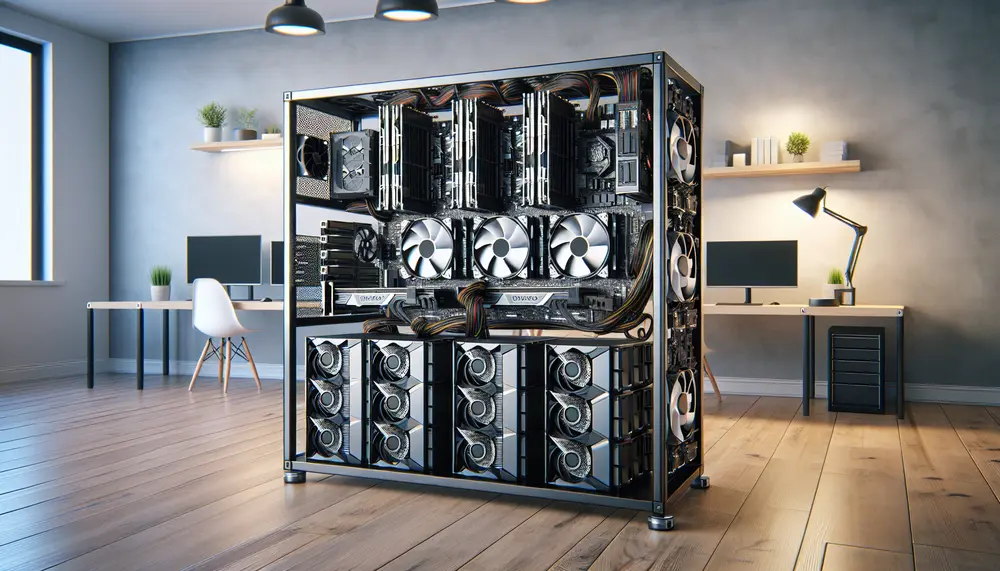
Running more than two GPUs requires a dedicated mining motherboard with sufficient PCIe slots — boards like the ASRock H110 Pro BTC+ or ASUS B250 Mining Expert support up to 13 cards and are battle-tested for 24/7 operation. Use powered PCIe risers (version 006C or later) exclusively; budget risers are the leading cause of fire risk and unexplained system instability in multi-GPU builds. Each riser should draw power from a separate SATA or Molex connector on the PSU, never daisy-chained.
PSU sizing demands a conservative approach: calculate your total GPU TDP at stock, add 20% headroom for the rest of the system, then add another 15% for PSU efficiency losses. A six-GPU rig running RTX 3060 Ti cards at 130W each requires at minimum an 1100W 80+ Gold unit — a 1200W or dual-PSU configuration is more reliable for long-term operation. For a complete walkthrough of frame selection, riser installation, BIOS settings, and OS configuration, the step-by-step rig build guide covers every hardware decision from chassis to cable management.
Cooling is frequently underestimated: GPU core temperatures should stay below 75°C and VRAM junction temperatures below 90°C under sustained load. Open-air frames with 20–25cm spacing between cards and targeted box fans positioned to create positive airflow across all heatsinks are standard practice. The hardware selection considerations that most impact long-term earnings extend beyond GPUs alone — motherboard stability, PSU quality, and thermal management directly determine uptime, and uptime is what converts hashrate into actual VTC rewards.
Maximizing Hashrate: Overclocking, Memory Tuning, and Cooling Strategies
Verthash, Vertcoin's proof-of-work algorithm, is heavily memory-bandwidth dependent by design. Unlike Ethash or KawPow, where raw shader performance drives efficiency, Verthash punishes memory-constrained configurations hard — meaning your tuning strategy needs to prioritize VRAM speed over core clock boosts. Getting this wrong doesn't just leave hashrate on the table; it can actively reduce your MH/s while increasing power draw simultaneously.
Memory Overclocking: Where Your Real Gains Are
On GDDR6 cards like the RTX 3060 or RX 6700 XT, memory overclocks of +1000 to +1500 MHz (effective) are typically achievable without stability issues, yielding 15–25% hashrate improvements over stock settings. GDDR6X cards, particularly the RTX 3080 and 3090, respond less linearly — the PAM4 signaling makes them more sensitive to memory overclocks, so increments of +200 MHz effective are more appropriate, testing stability with a 10-minute run before pushing further. AMD's RDNA2 cards benefit significantly from memory timing straps (1750, 1800 MHz straps applied via OverdriveNTool), sometimes adding another 5–8% on top of raw frequency gains. If you're working through systematic GPU-by-GPU optimization, the detailed breakdown on getting the most out of specific GPU architectures is worth cross-referencing before finalizing your profile.
Core clock reductions are counterintuitively effective for Verthash. Dropping the GPU core to 1000–1200 MHz on most mid-range cards maintains near-peak hashrate while cutting power consumption by 30–40 watts. Power limit adjustments of 65–75% of TDP are a reasonable starting point. The goal is finding the crossover point where power savings stop outpacing hashrate loss — usually around 1100 MHz core on RDNA2 and 1000–1050 MHz on Ampere.
Thermal Management Under Sustained Load
Verthash sustains extremely high VRAM utilization continuously, which means memory junction temperatures are your primary thermal concern — not GPU core temperature. On cards without exposed VRAM sensors (most pre-Ampere Nvidia), this requires either MSI Afterburner's memory temperature monitoring (where supported) or thermal imaging to validate. GDDR6 memory is rated to 95°C junction, but sustained operation above 85°C degrades long-term reliability and can cause throttling on newer cards. Adding aftermarket heatsinks or thermal pad replacements (going from 6W/mK stock pads to 12–14W/mK Fujipoly or Thermal Grizzly pads) regularly drops VRAM junction temps by 10–15°C on cards like the RTX 3080.
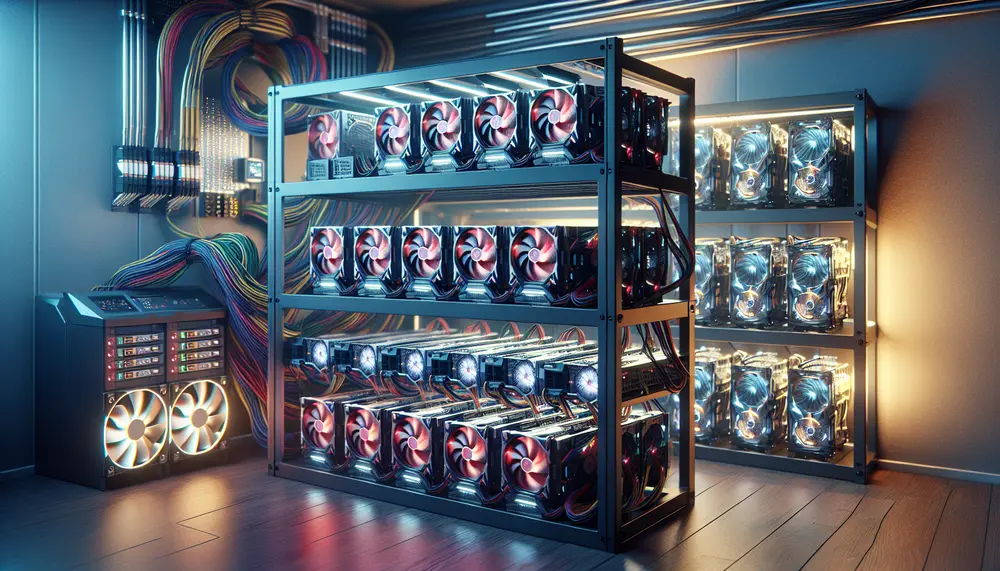
Fan curves deserve active management rather than leaving them on automatic. Set a target of 65–70°C core with fans running at 80–85% from the point mining starts — auto fan profiles react too slowly to the near-instant full-load transition. In rack or shelf configurations with multiple GPUs, ensure at least 50mm of airflow gap between cards; recirculated hot air compounds thermal problems faster than any other factor in multi-GPU setups.
Driver conflicts and incorrect GPU assignment can silently tank your effective hashrate without triggering obvious errors. If your reported hashrate looks lower than expected benchmarks suggest, the troubleshooting process for diagnosing cases where the miner isn't properly utilizing the GPU covers the most common culprits systematically. For a consolidated set of software-side and hardware-side adjustments that compound well with the physical tuning described here, the practical walkthrough on pushing Vertcoin hashrate beyond baseline configurations provides concrete next steps once your thermal foundation is stable.
Mining Pool vs. Solo Mining: Choosing the Right Strategy for Your Setup
The decision between pool and solo mining is arguably the most consequential strategic choice you'll make as a Vertcoin miner — and it's one that most guides oversimplify. The honest answer depends on three variables that interact in non-obvious ways: your total hashrate, your risk tolerance, and your monthly electricity cost structure. Get this calculation wrong and you'll either leave consistent income on the table or wait months for a block reward that statistically may never come.
The Mathematics of Solo Mining Viability
Vertcoin's network hashrate fluctuates, but as a reference point, consider a scenario where the network sits around 200 GH/s. A single GPU rig delivering 35 MH/s with the Verthash algorithm represents roughly 0.0175% of total network power. At current block times averaging around 2.5 minutes, your statistical expectation for a solo block extends to thousands of hours — meaning months of electricity costs with zero guaranteed return. This is pure variance, not a fixed schedule. You could find a block in week one or wait over a year.
The break-even threshold for solo mining Vertcoin in practical terms hovers around 5–10 rigs operating continuously, and even then you're accepting significant income volatility. If you're running a single GPU setup at home, the real trade-offs of attempting to mine Vertcoin alone become stark once you model out the variance against your fixed power costs. The math rarely favors the solo approach for small operations.
Pool Mining: Consistent Returns With Trade-Offs
Pool mining converts that probabilistic block reward into something resembling a predictable income stream. Most Vertcoin pools operate on a PPLNS (Pay Per Last N Shares) structure, which rewards loyalty — miners who stay in the pool during the actual block find earn proportionally more than those who hop between pools opportunistically. Pool fees typically range from 0% to 1%, which is negligible against the consistency benefits.
Choosing the right pool matters more than many miners realize. Pool luck, server uptime, minimum payout thresholds, and geographic server location all affect your actual take-home. A pool with frequent downtime costs you far more than a 0.5% fee difference. When evaluating your options, looking at pools that consistently rank for reliability and payout transparency gives you a concrete shortlist to work from rather than guessing based on forum recommendations alone.
Latency is a genuine factor with Verthash — high stale share rates from connecting to a geographically distant pool server erode your effective hashrate. Always benchmark your stale share percentage in the first 24 hours after joining a new pool. Anything above 2–3% stale shares is a red flag worth addressing.
- Pool size matters: Larger pools find blocks more frequently, smoothing out variance — smaller pools pay out larger chunks but less predictably
- Minimum payouts: Some pools set thresholds at 0.1 VTC, others at 1 VTC — relevant if you're running lower hashrate rigs
- Merged mining support: Certain pools allow mining auxiliary coins simultaneously without affecting your Vertcoin hashrate
- Pool transparency: Look for real-time luck statistics and publicly visible block history before committing
For most operators running between one and ten GPUs, pool mining is the strategically sound default. The deeper analysis of which specific pools offer the best combination of fee structure, server infrastructure, and payout reliability is covered in detail when comparing pools optimized specifically for consistent Vertcoin output. Your final choice should be revisited quarterly — pool dynamics shift as the network hashrate changes and pool operators adjust their infrastructure.
Profitability Analysis: Hashrate, Power Costs, and Real ROI Calculations
Vertcoin mining profitability hinges on three variables that interact dynamically: your GPU's hashrate on the Verthash algorithm, your local electricity cost in USD per kWh, and the current VTC/USD exchange rate. Unlike Bitcoin where industrial-scale ASICs dominate, Vertcoin's ASIC-resistance means a consumer GPU can genuinely compete — but "can compete" and "will profit" are two very different claims that require hard numbers.
Baseline Hashrate and Power Draw by GPU Tier
Verthash is a memory-hard algorithm, meaning GPU VRAM bandwidth is the primary performance driver, not raw shader count. A Radeon RX 580 8GB typically achieves 400–450 KH/s at roughly 85W under optimized settings. An RTX 3060 Ti hits approximately 800–950 KH/s at 110–130W after power limiting. At the high end, those mining with an RTX 3080 can expect around 1.6–1.8 MH/s while consuming 200–220W — making it one of the most hashrate-efficient options per watt in the consumer segment. These numbers assume properly tuned memory clocks and reduced power limits; stock settings typically waste 20–30% of potential efficiency.
The practical metric you should optimize for is KH/s per watt, not raw hashrate. A GPU drawing 300W at 1.5 MH/s performs worse on your electricity bill than one pulling 150W at 900 KH/s, depending on your power costs. Use HiveOS or NiceHash OS to monitor actual wall-power draw — software readings from GPU-Z often underreport system load by 15–25W.
Running the Real ROI Calculation
Start with your daily revenue estimate: plug your hashrate into WhatToMine or a dedicated tool to properly assess your expected VTC output against current network difficulty. At a network difficulty around 200K and VTC price of $0.25, a 1 MH/s rig generates roughly 8–12 VTC per day, translating to $2.00–$3.00 gross. Daily power cost for a 150W rig at $0.10/kWh equals $0.36, leaving $1.64–$2.64 net daily — before pool fees (typically 1–2%) and any cooling overhead.
Hardware ROI requires dividing your total investment by net daily profit. A used RX 580 purchased for $120 at the margins above breaks even in approximately 50–70 days. An RTX 3080 purchased new at $700–800 takes considerably longer and only becomes compelling if VTC appreciates significantly. This is precisely why understanding the full cost structure before committing capital separates profitable miners from those subsidizing the network.
Key variables to stress-test in your model:
- Electricity rate sensitivity: At $0.06/kWh, margins roughly double compared to $0.12/kWh — geographic location may be your single biggest profitability lever
- Difficulty adjustments: VTC uses Kimoto Gravity Well for retargeting; a sudden influx of miners can cut your daily output 20–40% within hours
- Price volatility: VTC has historically swung 300–400% within single quarters, making break-even timelines highly speculative
- Pool fees and payout thresholds: Smaller pools with PPLNS payment structures can delay realized revenue by days
For those learning how to extract consistent returns from GPU mining, the practical recommendation is to model three scenarios: current price, price down 50%, price up 100%. If the bear case still covers electricity within a reasonable timeframe, the setup is defensible. Mine-to-hold strategies require substantially lower break-even expectations and a conviction thesis on VTC's long-term value — which is an investment decision, not a mining decision.
Network Difficulty Fluctuations and Their Impact on Mining Returns
Vertcoin's network difficulty adjusts every block using the Kimoto Gravity Well (KGW) algorithm variant, which means difficulty recalibrates far more aggressively than Bitcoin's two-week adjustment window. In practice, this creates a highly dynamic environment where your effective hashrate share — and therefore your daily VTC earnings — can shift by 15–30% within hours, not weeks. Understanding this mechanism is not optional for serious miners; it's the difference between a profitable operation and one that bleeds electricity costs.
How Difficulty Algorithms Shape Your Daily Yield
When a significant number of GPU miners join the Vertcoin network simultaneously — typically after a price spike — the difficulty climbs sharply within 24–48 hours. A miner running four RX 580 cards at roughly 3.2 MH/s combined might see their daily yield drop from 12 VTC to 8 VTC purely due to difficulty increases, with no change in hardware or electricity consumption. The inverse is equally true: during mining exodus periods, difficulty drops can temporarily inflate rewards for remaining participants by 20–40%. When difficulty climbs consistently over multiple weeks, you need a concrete response strategy rather than simply waiting it out.
The Lyra2REv3 algorithm introduces an additional layer of complexity here. Because it was specifically engineered to be ASIC-resistant, the network difficulty baseline stays relatively low compared to SHA-256 chains. However, this also means that coordinated GPU botnets or sudden influxes of mining farm hardware can temporarily dominate block production, causing difficulty spikes that disproportionately hurt smaller operators running 2–6 GPU rigs.
Measuring and Responding to Difficulty Shifts
Tracking the difficulty-to-price ratio is the most actionable metric you can monitor. If VTC's price stagnates while difficulty increases 25% month-over-month, your break-even electricity cost per coin rises accordingly — on a 1,000W rig at $0.10/kWh, that can mean the difference between $0.80 and $1.10 cost per VTC mined. Tools like the Vertcoin block explorer and mining calculators that pull live difficulty data give you the granular view needed for these calculations. For a structured approach to these numbers, running a proper profitability analysis with current difficulty figures should happen at least weekly during volatile market conditions.
Practically speaking, difficulty fluctuations affect pool miners and solo miners very differently:
- Pool miners receive smoothed, proportional payouts — difficulty spikes reduce per-share value but don't eliminate income entirely
- Solo miners face high variance; a difficulty spike during an unlucky streak can mean days without a block reward, even with competitive hashrate
- Timing hardware upgrades during difficulty troughs maximizes early-period returns before the network compensates
- Monitoring the 7-day difficulty trend via mining pool dashboards provides better signal than single-day snapshots
The question of whether to mine solo or in a pool becomes particularly acute during high-difficulty periods. The variance risk of solo mining escalates considerably when difficulty is elevated, because expected time-to-block grows proportionally while your fixed costs — electricity, hardware depreciation — remain constant. Most operators with fewer than 50 MH/s find pool mining substantially more predictable during these windows, reserving solo attempts for periods when network difficulty sits at cyclical lows.
Low-Cost and Alternative Mining Approaches: Mobile and Entry-Level Options
Vertcoin's ASIC-resistance through the Verthash algorithm makes it uniquely accessible to miners who can't justify dropping $500–$3,000 on dedicated hardware. The algorithm was specifically engineered to keep GPUs and CPUs competitive, which opens the door to genuinely low-cost entry strategies — though with clear performance trade-offs you need to understand upfront.
Mobile Mining: Real Constraints, Niche Use Cases
Mining Vertcoin on a smartphone is technically possible, and if you want to explore that path, a step-by-step walkthrough for phone-based VTC mining covers the setup process in detail. Realistically, a flagship Android device with a Snapdragon 8 Gen 2 delivers somewhere between 50–150 H/s on Verthash — compared to 2,000–5,000 H/s on a mid-range GPU like an RX 580. The economics rarely make sense as a primary income source, but mobile mining has legitimate applications: testing pool configurations, learning the mining stack without financial risk, or contributing marginal hashrate during off-peak charging cycles in solar-powered setups.
Thermal throttling is the dominant technical problem. Most phones hit 40–45°C within 10–15 minutes of sustained mining load and throttle back to 40–60% of peak performance. If you run a device overnight without active cooling, you're accelerating battery degradation significantly — lithium-ion cells cycled at high temperatures lose 20–30% capacity within 300–500 cycles. Use mobile mining as an educational tool, not a production strategy.
Entry-Level GPU Builds and CPU Mining
For miners serious about low-cost GPU setups, older-generation cards offer a compelling value proposition. A used RX 470 or RX 480 (typically $60–$90 on the secondhand market) achieves 1,800–2,200 H/s on Verthash with a power draw of 100–130W after undervolting. Compare that to a brand-new RTX 4060 at $300+ delivering roughly 3,800–4,200 H/s — the cost-per-hashrate ratio often favors used Polaris-generation cards for bootstrapped operations. Before purchasing any hardware, running the numbers through a realistic VTC profitability assessment is essential, especially since electricity costs dominate the economics at this tier.
CPU mining deserves more attention than it typically receives in the Vertcoin community. Modern Ryzen 5 and Ryzen 7 processors — particularly the 5600X and 5700X — achieve 400–800 H/s on Verthash, drawing 65–95W under full mining load. For miners who already own these systems for general use, the marginal electricity cost (roughly $0.50–$1.20/day at $0.10/kWh) can generate intermittent rewards without dedicated hardware investment.
Key considerations when building a low-budget mining setup:
- Risers and motherboard compatibility: Budget multi-GPU rigs using B450/B550 boards with PCIe risers can run 2–4 used cards from a single $80–$120 motherboard
- PSU headroom: Always size your power supply at 80% of peak load — a 4-card RX 470 rig drawing ~500W needs a 650W unit minimum
- Mining OS options: HiveOS and minerstat both offer free tiers for 1–3 rigs, eliminating Windows licensing costs
- Pool selection: Vertcoin's 1-Click Miner connects directly to the p2pool network, eliminating pool fees entirely for small operators
For a comprehensive look at how different hardware tiers compare in actual hash output and efficiency, the hardware comparison covering VTC-optimized mining equipment breaks down the full spectrum from budget builds to high-performance rigs. The low-cost path is genuinely viable for Vertcoin in a way it simply isn't for SHA-256 or Ethash networks — that's the practical payoff of ASIC resistance done right.
Scaling a Vertcoin Mining Operation: Multi-GPU Rigs, Pool Optimization, and Long-Term Infrastructure
Moving from a single-GPU setup to a scaled multi-GPU operation requires more than just adding hardware — it demands a systematic approach to power distribution, thermal management, and pool strategy. Most miners who fail at scaling underestimate the compounding costs: each additional GPU not only draws more watts but increases cooling requirements non-linearly. A 6-GPU rig running six RX 580s at 130W each doesn't just consume 780W — factor in riser cards, motherboard, CPU, RAM, and PSU inefficiency, and your real wall-draw sits closer to 950–1,050W under load.
Building and Managing Multi-GPU Infrastructure
The foundation of any scalable Vertcoin operation is a purpose-built open-frame rig that prioritizes airflow over aesthetics. When constructing a rig designed for long-term 24/7 operation, spacing GPUs at minimum 4cm apart prevents thermal throttling that silently kills hashrate and hardware longevity. A common mistake is running multiple rigs on a single 20A circuit — at 80% safe load, you have roughly 1,920W per circuit, which supports roughly one heavy 6-GPU rig or two lighter configurations. Dedicated circuits per rig aren't optional at scale; they're insurance against fires and breaker failures.
PCIe riser quality is the most underrated failure point in multi-GPU builds. Cheap risers cause instability, rejected shares, and in worst cases, electrical fires. Invest in powered risers with individual fusing, and replace them every 12–18 months regardless of visible condition. For motherboard selection, boards like the ASRock H110 Pro BTC+ supporting 13 GPUs give you flexibility, but mixing GPU models on a single rig often creates driver conflicts — keeping GPU models uniform per rig simplifies troubleshooting dramatically.
Pool Strategy and Hashrate Optimization at Scale
At scale, pool selection shifts from a secondary concern to a primary profitability lever. Pool fee structures matter significantly when you're contributing 50+ MH/s — a 1% fee difference on meaningful hashrate translates directly to bottom-line returns. When evaluating pools that genuinely maximize your payout efficiency, prioritize those with PPLNS (Pay Per Last N Shares) reward systems, transparent fee structures, and active development communities. P2Pool remains philosophically aligned with Vertcoin's ASIC-resistance ethos, but its higher variance payouts suit miners who can sustain operations through dry spells.
Network latency to pool servers directly impacts stale share rates. Stale shares above 2% represent real lost revenue. Test ping times to pool servers from your mining location and, if you're running multiple rigs, consider geographic distribution across two pools for redundancy. The practical techniques that push hashrate efficiency higher include aggressive memory junction temperature management and fine-tuned power limits per-GPU rather than blanket undervolting profiles.
Long-term infrastructure planning means treating your operation like the business it is. Track per-rig profitability using actual wall-meter readings, not software estimates. Hardware depreciation on GPUs in a mining context runs roughly 30–40% annually under continuous load. Extracting maximum performance from each GPU through memory overclocking and power limit tuning extends the productive lifespan of your hardware while improving ROI timelines. Maintain a spare parts inventory — at minimum, keep replacement risers, thermal paste, and one spare PSU on hand to minimize downtime that directly costs revenue.
- Dedicated 20A circuits per rig — never share with household loads
- Uniform GPU models per rig to eliminate driver conflicts
- Real-time power monitoring via smart plugs with energy tracking (TP-Link Kasa EM series works well)
- Monthly thermal maintenance — dust cleaning, thermal pad replacement every 6 months on memory modules
- Stale share monitoring — investigate immediately if rates exceed 1.5%
FAQ about Vertcoin Mining
What is Vertcoin mining?
Vertcoin mining is the process of validating transactions and creating new units of Vertcoin by solving complex mathematical problems using GPUs. This process is designed to be accessible to everyday users to maintain network decentralization.
How does Verthash algorithm support GPU mining?
The Verthash algorithm is memory-hard and I/O-bound, intentionally designed to favor GPUs over ASICs by requiring frequent reads from a large DAG file, thus making it economically impractical to create ASICs that outperform consumer GPUs.
What are the best GPUs for Vertcoin mining?
High-memory bandwidth GPUs such as NVIDIA's RTX 3060 Ti and RTX 3070 are some of the best options for Vertcoin mining. Cards with at least 8 GB of VRAM are ideal, as they can efficiently handle the Verthash algorithm's requirements.
Is it better to mine Vertcoin solo or in a pool?
For most miners, pool mining is a more strategic choice as it provides more consistent returns compared to solo mining, which can lead to unpredictable rewards depending on network conditions and personal hashrate.
How does network difficulty affect mining returns?
Network difficulty in Vertcoin adjusts dynamically with each block, meaning that fluctuations can directly impact your earnings. Increased difficulty can lower the amount of Vertcoin mined per unit of hashrate, highlighting the need for miners to stay aware of these changes.