Table of Contents:
GPU Performance Benchmarks: Hashrate Capabilities Across Hardware Generations
Understanding how GPU generations stack up against each other is the foundation of any serious mining operation. Raw hashrate numbers pulled from manufacturer specs rarely reflect real-world mining performance — thermal throttling, driver versions, memory type, and power limits all compress or expand what a card actually delivers on your rig. The gap between theoretical and practical output can easily reach 15–25%, which at scale translates directly into missed revenue.How Hardware Generations Define Your Mining Economics
The Pascal-to-Ampere transition fundamentally changed the hashrate-per-watt equation. Older Pascal cards like the GTX 1080 were never optimized for memory-intensive mining algorithms — their GDDR5X memory architecture created bottlenecks on Ethash that limited effective hashrates. If you want to push a legacy card to its ceiling, the memory timing optimization strategies for the GTX 1080 remain surprisingly relevant for operators still running mixed-generation farms. Turing cards like the GTX 1660 Super were the first Nvidia consumer GPUs to ship with GDDR6, and that single change delivered a step-change improvement in memory bandwidth efficiency. On Ethash, a stock 1660 Super typically delivered 26–28 MH/s at around 80W after tuning — an efficiency ratio that made it a staple of mid-tier farm builds from 2020 onward. For operators still evaluating Turing hardware, understanding the 1660 Super's hashrate ceiling and power profile is essential before committing to bulk purchases on the secondary market. Ampere changed everything again. The RTX 30-series introduced higher-bandwidth GDDR6X on flagship models and revised memory controllers across the lineup. The RTX 3060 occupies a particularly interesting position — Nvidia initially shipped it with a software-enforced hashrate limiter targeting Ethash, then partially unlocked it through driver updates. Breaking down the RTX 3060's actual mining performance requires understanding which driver version you're running, whether the card is a 12GB or LHR variant, and how your overclock profile interacts with the limiter logic.Where Data Center GPUs Fit the Mining Calculus
The H100 represents an entirely different category — Nvidia's Hopper architecture was built for AI inference and HPC workloads, not consumer mining rigs. Yet its memory bandwidth specifications (up to 3.35 TB/s on the SXM5 variant) generate legitimate questions about its theoretical ceiling on memory-bound algorithms. Evaluating the H100's hashrate potential matters primarily for operators who already have access to data center infrastructure and are exploring dual-use scenarios, not for anyone building from scratch. When benchmarking across generations, track these metrics consistently:- MH/s per watt — the single most important operational metric after electricity costs exceed hardware depreciation
- Memory junction temperature — GDDR6X cards like the RTX 3080 thermal throttle aggressively above 104°C mem junction, costing 5–8% hashrate
- Core vs. memory clock contribution — on Ethash-derived algorithms, memory OC delivers 3–5x more hashrate gain per MHz than core OC
- Stock vs. tuned delta — properly tuned Ampere cards typically deliver 20–30% higher efficiency than stock settings
Budget Mining Hardware: Cost-Efficiency Analysis for Entry-Level Equipment
Entry-level mining hardware sits in a strange paradox: low acquisition costs mask hidden inefficiencies that erode profitability faster than most newcomers expect. The real metric isn't price per GPU — it's cost per megahash per watt, and that number tells a brutally different story than the sticker price on a secondhand GPU listing. Before committing capital to budget equipment, you need to understand exactly where the breakeven curve sits relative to your local electricity rate.
The Real Numbers Behind Budget GPU Mining
Older Pascal-architecture cards like the GTX 1050 Ti and GTX 750 Ti remain popular entry points precisely because they're cheap to acquire — often $40–$80 on the secondhand market. However, their efficiency profiles vary dramatically by algorithm. The GTX 1050 Ti pulls around 75W while delivering roughly 13–15 MH/s on Ethash-based algorithms, which translates to a power efficiency of approximately 0.18 MH/W. If you want to squeeze that hardware to its ceiling, understanding the specific tuning parameters that push the 1050 Ti's performance is essential before assuming stock settings are good enough. Similarly, the GTX 750 Ti — despite its age — consumes only 55–60W, making it viable in regions with sub-$0.05/kWh electricity, though extracting maximum efficiency from the 750 Ti requires aggressive memory timing adjustments and careful undervolting.
Get $500 free Bitcoin mining for a free testing phase:
- Real daily rewards
- 1 full month of testing
- No strings attached
If you choose to buy after testing, you can keep your mining rewards and receive up to 20% bonus on top.
The transition to Turing and Ampere-based budget cards changes the calculation significantly. The RTX 3050, for instance, introduces hardware-level LHR (Lite Hash Rate) limitations on Ethereum-based workloads, but performs competitively on algorithms like Ergo or Flux. The 3050's actual mining throughput across multiple algorithms reveals that its 80W TDP ceiling makes it one of the more efficient sub-$200 options currently available, particularly after memory overclock.
Evaluating True Cost-Efficiency: What the Calculators Miss
Most online mining calculators ignore three costs that matter enormously at the budget tier: resale value depreciation, driver and software overhead, and thermal wear on secondhand hardware. A GTX 1070 purchased for $120 might look profitable at $0.07/kWh, but if the card shows artifacts within six months due to prior mining abuse, your effective ROI collapses. That said, properly sourced 1070s remain genuinely capable — optimizing the 1070's hashrate through memory and power tuning can push efficiency from 26 MH/s at 150W down to 28 MH/s at 115W with the right OC profile.
When evaluating any budget mining purchase, apply this filtering framework:
- Payback period under 6 months at your local electricity rate — anything longer exposes you to excessive market volatility risk
- Secondhand GPU provenance check — ask for GPU-Z screenshots showing sensor history and run a 30-minute stress test before finalizing any purchase
- Algorithm flexibility — hardware locked to a single profitable algorithm is a liability; multi-algorithm compatibility extends equipment lifespan significantly
- Driver support lifecycle — cards with discontinued driver support create operational overhead that eats into thin margins at scale
Budget mining hardware can generate meaningful returns, but only when acquisition cost, efficiency, and operational risk are evaluated together rather than in isolation. The $80 GPU that requires $150 in supplementary cooling, risers, and PSU headroom isn't the bargain it appears on paper.
ASIC vs. GPU vs. CPU: Choosing the Right Mining Machine Architecture
The architecture decision sits at the core of every mining operation, and getting it wrong means burning capital on hardware that will never recoup its investment. Each platform has a distinct performance envelope, cost structure, and algorithmic compatibility — and the market has evolved to the point where the wrong choice doesn't just underperform, it becomes stranded asset territory within 18 months.
ASIC Miners: Maximum Efficiency, Zero Flexibility
Application-Specific Integrated Circuits represent the pinnacle of purpose-built mining efficiency. Bitmain's Antminer S21 Pro delivers 234 TH/s at roughly 17.5 J/TH — a figure that no GPU cluster can match for SHA-256. The trade-off is absolute: ASICs are hardwired to a single algorithm. If the network forks, pivots to ASIC-resistant hashing, or the coin collapses, your hardware has no fallback. For Bitcoin and Litecoin mining, this is the only architecture that generates real margins in 2024; anything else is a hobby at best. Before committing to specific models, consulting independent hardware assessments that break down real-world performance metrics is non-negotiable due diligence.
ASICs also carry significant upfront costs and longer ROI timelines. Entry-level units start around $2,000, while flagship machines push $8,000–$12,000. Secondary market pricing adds another layer of complexity — a used S19j Pro purchased at the wrong point in the cycle can take 36+ months to break even at typical industrial electricity rates of $0.05–$0.07/kWh.
GPU Mining: Algorithmic Flexibility at a Cost Premium
Graphics Processing Units remain relevant specifically because of their versatility. An NVIDIA RTX 4090 hashing Ethereum Classic on Etchash at roughly 130 MH/s, or pivoting to Kaspa, Ergo, or Ravencoin — this multi-algorithm capability is the GPU's only defensible advantage. A 6-GPU rig running RTX 3080s might cost $6,000–$8,000 to build and consume 900–1,200W continuously, making electricity cost management critical. Understanding the full financial picture behind building a competitive mining rig — including power infrastructure, cooling, and depreciation — separates profitable operations from those that simply look profitable on paper.
The GPU market shifted dramatically after Ethereum's merge to Proof-of-Stake in September 2022. Overnight, hundreds of thousands of ETH miners flooded the secondary market with cards, crashing resale values. GPU miners now operate in a fragmented altcoin landscape where profitability windows open and close within weeks, requiring active portfolio management of both coins and algorithms.
CPU Mining: Where It Still Makes Sense
Central Processing Units are largely irrelevant for major proof-of-work coins, but they retain a niche in RandomX-based Monero mining, where the algorithm is explicitly designed to favor CPU architecture. A Ryzen 9 7950X achieves approximately 70 KH/s on RandomX — competitive enough for small-scale XMR mining. Curiosity about how mainstream Intel processors stack up for hashrate output reveals the ceiling quickly: even modern i5 chips cap out around 10–15 KH/s, which generates cents per day at current network difficulty. Apple Silicon is a separate conversation — the architectural advantages of unified memory mean the M2 Ultra's performance characteristics on certain workloads genuinely surprise benchmarkers, though economic viability remains marginal.
The practical selection framework reduces to three variables: target algorithm, electricity rate, and time horizon. Operations with sub-$0.05/kWh power and 24-month commitments belong in ASICs. Flexible retail operations or those hedging against algorithm shifts should look at GPUs. CPU mining only pencils out when hardware is already sunk cost or when running Monero at small scale with free power.
Regional Bitcoin Mining Machine Markets: Pricing, Supply Chains and Local Dynamics
The global mining hardware market is anything but uniform. A Bitmain Antminer S21 Pro that sells for $2,800 at an authorized distributor in the United States can cost $3,400 or more by the time it clears customs and reaches an operator in West Africa. These price gaps aren't arbitrary — they reflect layered import duties, currency exposure, logistics costs, and the fragmentation of regional distribution networks. Understanding how these dynamics play out in specific markets is essential before committing capital to hardware procurement.
Emerging Markets: High Demand, Structural Friction
Emerging market miners face a distinctive combination of strong motivation and structural disadvantage. Electricity arbitrage opportunities in countries like Nigeria, Ethiopia, and Kazakhstan have drawn significant operator interest, yet hardware acquisition remains the primary bottleneck. In Nigeria specifically, import duties on electronics typically run between 5–20%, and currency volatility against the USD adds another layer of cost unpredictability. A detailed breakdown of what hardware actually costs Nigerian operators — including shipping, customs, and last-mile logistics — reveals total landed costs routinely 25–40% above the manufacturer's list price.
India presents a different profile but comparable friction. The country's 2022 GST framework applied an 18% goods and services tax to crypto mining equipment, fundamentally shifting the economics for domestic operators. Gray market imports through unofficial channels have remained common as a result, though they carry significant warranty and customs risk. Operators looking to understand how India's mining hardware ecosystem actually functions need to factor in not just GST but also the RBI's evolving stance on crypto infrastructure investment, which affects capital availability for equipment purchases.
Mature Markets: Liquidity, Secondary Markets, and Price Discovery
In North America and Western Europe, the hardware market is considerably more liquid. Secondary market platforms like Kaboomracks, Luxor's ASIC trading desk, and various OTC brokers provide genuine price discovery, with machines trading at well-documented efficiency-adjusted multiples. The general rule of thumb — that machines delivering below 25 J/TH are premium-priced while anything above 35 J/TH trades at distressed levels — holds reasonably well in these markets. During the 2022 bear market, S19j Pro units dropped from $10,000+ to under $1,500, creating acquisition opportunities that informed operators capitalized on aggressively.
Regional supply chain dynamics also affect lead times in ways that directly impact operational planning. Chinese manufacturer shipping windows, typically 4–8 weeks for standard orders, can stretch to 16+ weeks during bull market demand surges. Operators in Southeast Asia generally benefit from shorter logistics chains and stronger relationships with Tier-1 manufacturers. For operators anywhere in the procurement process, accurately calculating the full economic cost of a mining rig — beyond sticker price — requires honest accounting of these regional variables.
Practical procurement considerations vary significantly by geography:
- Currency hedging: Operators purchasing in regions with volatile local currencies should negotiate USD-denominated contracts wherever possible to avoid mid-order exposure
- Warranty enforcement: Bitmain and MicroBT warranty claims require original purchase documentation; gray market units often lack this, creating significant repair cost risk
- Batch timing: Buying during network difficulty downturns — when spot prices drop and seller urgency increases — consistently yields 15–30% better hardware cost per TH/s
- Regional reseller vetting: Authorized distributors in the EMEA and APAC regions vary considerably in reliability; cross-referencing manufacturer authorization lists is non-negotiable
The most sophisticated regional operators treat hardware procurement as an ongoing market activity, not a one-time decision. They track hashprice trends, maintain distributor relationships across multiple geographies, and build flexibility into their capital allocation to move quickly when acquisition windows open.
Experimental and Non-Conventional Mining Hardware: Limits and Learning Potential
Not every mining experiment is designed to generate profit. Engineers, researchers, and hobbyists regularly push unconventional hardware through SHA-256, Ethash, or RandomX workloads not to fill wallets, but to understand the fundamental computational boundaries of general-purpose silicon. This category of mining—call it educational or experimental—has produced real insights into memory bandwidth constraints, thermal throttling behavior, and algorithm sensitivity that commercial ASIC vendors rarely disclose.
Single-Board Computers and Microcontrollers: Where the Floor Is
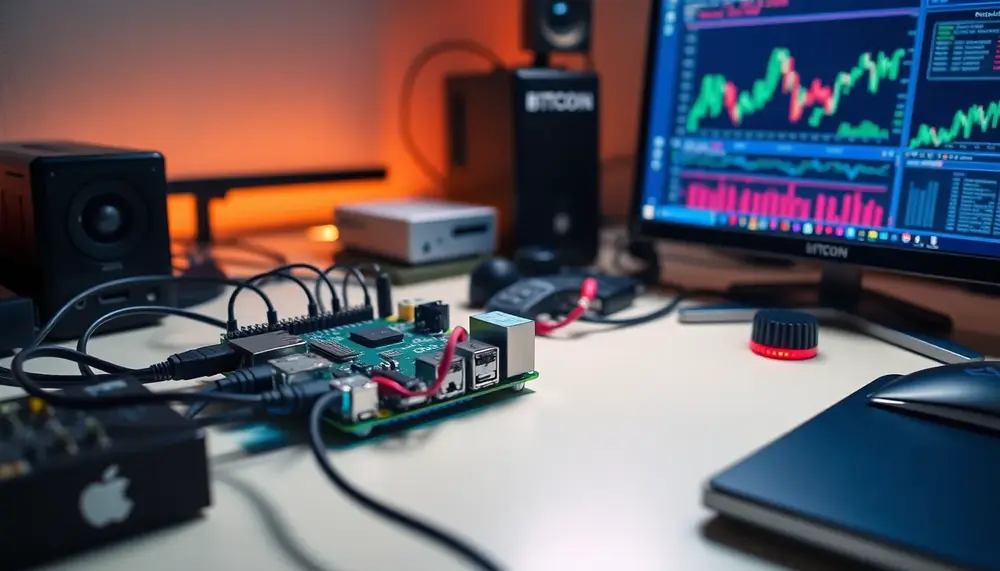
The Raspberry Pi 4, equipped with a Cortex-A72 quad-core processor running at 1.8 GHz, is a recurring subject in this space. Its actual hashrate performance across different algorithms reveals a hard truth: CPU-bound architectures without hardware AES acceleration or dedicated hash engines simply cannot compete, delivering roughly 100–200 H/s on RandomX—a figure that costs more in electricity than it generates by several orders of magnitude. But the Pi's value here is diagnostic, not financial.
Even more illustrative is the Arduino Uno, an 8-bit AVR microcontroller running at 16 MHz with 2 KB of SRAM. Testing the Arduino's viability for any mining workload makes immediately clear why SHA-256 requires dedicated silicon: the Uno manages approximately 50 H/s under ideal conditions, consuming enough energy relative to output to classify the exercise purely as a learning tool. What it does teach is invaluable—how nonces are iterated, how block headers are structured, and where hardware bottlenecks emerge at the instruction level.
Working with these constrained devices forces a deeper engagement with mining protocol internals than any simulator provides. You're debugging actual stratum communication failures, watching memory overflow behaviors, and measuring real power draw with a USB meter—not estimating from a spec sheet.
High-Performance Server GPUs: Ceiling-Level Benchmarks
At the other extreme, data center GPUs like the NVIDIA V100 offer a different kind of experimental value. Originally designed for deep learning workloads with its 5,120 CUDA cores and 900 GB/s HBM2 memory bandwidth, the V100 was never marketed as mining hardware. Yet tuning the V100's output for mining efficiency demonstrates how memory subsystem architecture—not just raw clock speed—determines algorithm-specific performance. On Ethash, the V100 can achieve 90+ MH/s, but at a power draw exceeding 250W and a hardware acquisition cost that makes ROI nearly impossible in consumer mining contexts.
The practical takeaways from non-conventional hardware experimentation include:
- Algorithm-architecture fit matters more than raw compute—a 64-bit ARM CPU outperforms a faster 32-bit MCU on RandomX due to integer pipeline depth
- Memory latency, not throughput alone, determines Ethash and similar memory-hard algorithm performance
- Thermal headroom on non-mining hardware is often insufficient for sustained 100% load—throttling typically begins within 10–15 minutes on unmodified server GPUs without active fan control
- Driver and firmware compatibility with mining software requires manual patching on most unconventional platforms
For practitioners building custom mining rigs or evaluating novel algorithm implementations, running controlled tests on this spectrum of hardware—from microcontroller to HPC GPU—provides a calibration framework that no datasheet replicates. The losses are the price of the education.
Mining Pool Infrastructure: Nodes, Software and Operational Setup
Running a mining pool is fundamentally a distributed systems engineering challenge. The infrastructure stack sits between your miners and the blockchain itself, handling share validation, reward distribution, and network communication simultaneously. A poorly configured pool backend can cost you thousands in orphaned blocks, unpaid shares, and downtime — problems that become exponentially more expensive as your operation scales past 10 PH/s.
Node Architecture and Connectivity
Every pool requires at least one full blockchain node running in sync with the network. This node validates incoming blocks, broadcasts solved solutions, and feeds your pool software with the current block template. For serious operations, running a minimum of three geographically distributed nodes is standard practice — one in North America, one in Europe, and one in Asia covers the major hashrate regions and reduces propagation latency to under 80ms for most miners. Before diving into hardware specs and hosting decisions, understanding what distinguishes the pool software layer from the underlying node infrastructure prevents costly architectural mistakes early on.
Node hardware requirements are often underestimated. A Bitcoin full node in 2024 needs at minimum a 4-core CPU, 16GB RAM, and 600GB+ NVMe storage for the full UTXO set and chain data. For pools processing over 1,000 worker connections, dedicated bare-metal servers outperform VPS instances significantly — network I/O bottlenecks on shared virtualized environments directly translate to higher stale share rates, typically adding 0.3–0.8% inefficiency per 100ms of added latency.
Pool Software Selection and Configuration
The choice of pool software determines your supported payout schemes, monitoring capabilities, and long-term scalability ceiling. Leading open-source solutions each have distinct trade-offs — NOMP (Node Open Mining Portal) handles multi-coin setups well, while CKPool and its variants dominate high-performance single-coin deployments. Commercial options like Luxor's pool backend add professional support contracts but lock you into vendor ecosystems.
Critical configuration parameters that operators frequently misconfigure include vardiff settings (variable difficulty), share submission windows, and block notification mechanisms. Set your minimum difficulty too low and you'll flood your database with millions of low-value shares. Set it too high and modern ASIC miners running at 200+ TH/s will experience artificial work gaps. A well-tuned vardiff algorithm targets 8–16 shares per minute per worker connection regardless of individual miner hashrate.
For operators building their infrastructure from scratch, following a structured node deployment procedure prevents the configuration drift that causes intermittent validation failures weeks after launch. Key steps include properly configuring RPC authentication, enabling ZMQ notifications for real-time block propagation, and implementing watchdog scripts that restart crashed processes within seconds rather than waiting for manual intervention.
The operational stack beyond the core software matters equally:
- Database layer: Redis handles live share tracking; PostgreSQL or MySQL stores historical payouts. Separate these onto distinct servers above 50 TH/s pool size.
- Stratum proxy: Reduces direct connections to your pool server, enabling horizontal scaling without reconfiguring individual miners.
- Monitoring stack: Grafana + Prometheus dashboards tracking shares/second, worker counts, and block find rates with alerting thresholds set at 2-sigma deviations from baseline.
- DDoS mitigation: Mining pools are frequent attack targets. BGP anycast routing or services like Cloudflare Spectrum protect Stratum ports specifically.
Operators who understand the share validation and reward distribution mechanics at a conceptual level make consistently better infrastructure decisions — knowing that PPLNS payout windows require persistent share history changes your database retention and backup strategy fundamentally compared to simpler PPS models.
FAQ zur Auswahl von Mining Equipment für 2026
Was sind die wichtigsten Faktoren bei der Auswahl von Mining Equipment?
Wichtige Faktoren sind die Energieeffizienz, die Hashrate, die Anschaffungskosten, die Wartungskosten und die Flexibilität in Bezug auf unterstützte Algorithmen.
Welche Arten von Mining Equipment gibt es?
Es gibt drei Haupttypen von Mining Equipment: ASIC-Miner für spezifische Algorithmen, GPU-Rigs für mehr Flexibilität und CPU-Mining für bestimmte Anwendungen wie RandomX.
Wie kann ich die Rentabilität meines Mining Equipments bewerten?
Die Rentabilität kann durch die Berechnung der Kosten pro Megahash pro Watt sowie die Berücksichtigung von Strompreisen und möglichen Resale-Werten bewertet werden.
Welche Rolle spielt die Kühlung bei Mining Equipment?
Kühlung ist entscheidend, da Überhitzung die Leistung verringern kann. Gut geplante Kühlsysteme und Luftstrom sind wichtig, um optimale Betriebstemperaturen zu halten.
Wie finde ich die besten Angebote für Mining Equipment?
Das Vergleichen von Preisen auf verschiedenen Plattformen, das Verfolgen von Markttrends und das Überwachen von Kaufmöglichkeiten während Marktschwankungen sind effektive Methoden, um gute Angebote zu finden.