Table of Contents:
How the Scrypt Algorithm Defines Litecoin Mining Hardware Choices
When Charlie Lee designed Litecoin in 2011, the choice of Scrypt as its proof-of-work algorithm was deliberate and consequential. Unlike Bitcoin's SHA-256, Scrypt was engineered to be memory-hard — meaning it requires significant RAM bandwidth alongside raw computational power. This single architectural decision has shaped every hardware choice Litecoin miners have made for over a decade, and understanding it is the foundation of any serious mining operation.
Scrypt's memory-hardness stems from how it generates and repeatedly accesses a large pseudorandom lookup table during the hashing process. Early parameters required roughly 128 KB of memory per hash instance, which was specifically designed to make parallel computation on standard GPUs expensive. The irony is that while Scrypt initially resisted ASIC development longer than SHA-256, purpose-built Scrypt ASICs eventually emerged and have completely dominated the landscape since roughly 2014. Today, no serious Litecoin miner runs GPUs — the hashrate differential is simply too extreme.
Get $500 free Bitcoin mining for a free testing phase:
- Real daily rewards
- 1 full month of testing
- No strings attached
If you choose to buy after testing, you can keep your mining rewards and receive up to 20% bonus on top.
Why Scrypt ASICs Are Fundamentally Different from SHA-256 Hardware
A SHA-256 ASIC like those used in Bitcoin mining can be reduced to an extraordinarily efficient sequence of bitwise logic operations. Scrypt ASICs face a harder engineering challenge: they must incorporate substantial on-chip memory to hold the working data arrays. This means Scrypt chip designs carry higher die area costs, which historically made them more expensive to produce per terahash than their Bitcoin counterparts. The memory bandwidth bottleneck means you cannot simply stack more processing cores to linearly increase hashrate — each core needs proportional memory access, driving up chip complexity.
This constraint directly explains why, when evaluating any Scrypt miner, you need to look at the J/MH (joules per megahash) efficiency metric rather than raw hashrate alone. For example, the Bitmain Antminer L7 delivers around 9,500 MH/s at approximately 3,425 watts — a benchmark that, as explored in detail when comparing current-generation Scrypt mining hardware, few competitors can match on efficiency grounds. Older units like the L3+ produced just 504 MH/s at 800W, a stark illustration of how rapidly the hardware generation gap compounds in Scrypt mining.
Practical Implications for Hardware Selection
Understanding Scrypt's architecture leads directly to actionable purchasing criteria. Before acquiring any unit, verify these specifications:
- MH/s rating under real operating conditions, not manufacturer peak figures
- Power consumption at the wall, accounting for PSU efficiency losses of typically 6–10%
- Cooling requirements, since Scrypt ASICs run hot and thermal throttling degrades hashrate significantly
- Firmware maturity and availability of third-party options for tuning
The infrastructure requirements that support Scrypt mining operations go well beyond the ASIC unit itself — power delivery, ventilation, and network stability all interact with how the algorithm's memory demands translate into real-world uptime. A miner running at 95% uptime due to thermal issues loses more revenue than one paying slightly higher electricity costs with stable performance.
For those evaluating specific hardware tiers, the contrast between the flagship L7's performance profile and the economics of running legacy equipment like the L3-series units in an optimized low-cost setup illustrates how Scrypt's memory-hard properties affect profitability across completely different operational contexts. The algorithm doesn't change — but the hardware generation you run determines whether those properties work in your favor or against you.
ASIC vs. GPU vs. CPU: Choosing the Right Mining Hardware for LTC
Hardware selection is the single most consequential decision in your Litecoin mining operation. Get it wrong and you'll bleed electricity costs before earning a meaningful return. Litecoin uses the Scrypt hashing algorithm, which was originally designed to be memory-intensive and ASIC-resistant — that vision didn't hold, and today the hardware landscape has stratified dramatically across three distinct categories, each with its own economic profile.
ASICs: The Industrial Standard for Serious Mining
Application-Specific Integrated Circuits dominate Litecoin mining in 2024, and the numbers explain why. The Antminer L9, Bitmain's current flagship Scrypt ASIC, delivers around 16 GH/s at roughly 3,360W — translating to an efficiency ratio of approximately 0.21 J/MH. Compare that to any GPU setup and the efficiency gap becomes unbridgeable for competitive solo or pool mining. Scrypt ASICs from manufacturers like Bitmain, MicroBT, and Goldshell have pushed network difficulty to levels where non-ASIC hardware simply can't mine profitably at scale.
The trade-offs are real, however. ASICs are single-purpose machines — if Litecoin's price collapses or the algorithm changes, your hardware has zero residual utility. Upfront costs for a competitive unit run $2,000–$8,000, and you're entirely dependent on manufacturer supply chains. For anyone evaluating the full hardware spectrum before committing capital, a detailed breakdown of each device's real-world hashrate and ROI timelines is essential reading before purchase.
GPUs and CPUs: Niche Use Cases, Not Dead Ends
GPUs running Scrypt deliver roughly 500–900 KH/s per card on mid-to-high-end hardware like the RX 6800 XT or RTX 3080. That's orders of magnitude below ASIC performance, yet GPU mining retains genuine relevance in specific scenarios: testing pool configurations, mining smaller Scrypt-based altcoins alongside LTC, or operating in regions with sub-$0.03/kWh electricity that shifts the profitability math. If you're building or optimizing a GPU rig specifically for Litecoin, understanding how Scrypt workloads behave across different GPU architectures will save you from misconfigured memory clock settings that kill efficiency. Beyond architecture, card selection matters enormously — the difference between a well-chosen and a poorly-chosen GPU can mean 30–40% variance in MH/W output, which is why identifying which specific cards deliver the best hashrate-per-watt for Scrypt is worth the research time.
CPU mining Litecoin in a production context is essentially obsolete — a modern 16-core CPU achieves roughly 20–50 KH/s on Scrypt, consuming 65–125W for near-zero block reward probability. The legitimate use case for CPU mining today is educational: learning pool mechanics, validating your software stack, or running a testnet node. Those looking to experiment at this level should consult resources on which mining clients handle CPU Scrypt workloads most efficiently, since software overhead matters disproportionately when hashrate is already minimal.
The practical decision framework comes down to three variables: available capital, electricity cost, and operational flexibility needs. Operators with $5,000+ budgets and locked-in cheap power should go straight to ASICs. Those with existing GPU rigs, flexible power situations, or multi-coin strategies have a legitimate case for GPU setups. CPU mining belongs strictly in the learning-and-testing category — never in a profit-focused deployment.
Setting Up Your Litecoin Mining Operation: Software, OS, and Configuration
Getting your hardware running efficiently is only half the battle. The software stack you choose — mining client, operating system, and pool configuration — directly determines whether you're leaving hashrate and profitability on the table. Miners who spend time optimizing their software setup typically see 5–15% better performance compared to those running default settings out of the box.
Choosing the Right Operating System
For ASIC miners like the Antminer L7 or Bitmain L3+, the firmware is largely self-contained, so your OS choice is mostly about the management machine monitoring your fleet. Linux dominates this space for good reason: lower overhead, superior process stability for 24/7 operations, and far better remote management via SSH. If you're running GPU rigs for Scrypt mining, HiveOS and minerstat are the two platforms worth your attention — HiveOS charges nothing for up to three rigs, while minerstat's monitoring granularity is unmatched for larger operations. Windows remains viable for single-rig hobbyists, but expect higher idle CPU usage and occasional driver conflicts that kill uptime. If you want a detailed walkthrough for Linux environments, the process of configuring a miner from scratch on a Linux system covers everything from dependency installation to auto-start scripts. Mac users aren't left out either — though less common in production environments, running Litecoin mining software on macOS is achievable with the right toolchain setup.
Mining Software Selection and Configuration
CGMiner remains the gold standard for ASIC control, offering low-level hardware access, temperature monitoring, and fan speed control that proprietary dashboards often lack. BFGMiner is a strong alternative with modular architecture and built-in stratum proxy support — useful when you're running 10+ units pointing at the same pool. For GPU-based Scrypt mining, TeamRedMiner and CryptoDredge consistently post the best benchmark numbers on AMD and NVIDIA hardware respectively. Never run the stock firmware on older ASIC units if custom options exist — Antminer L3+ units running Hiveon's custom firmware, for example, regularly achieve 10–12% hashrate gains alongside more aggressive thermal profiles.
Pool configuration deserves the same rigor you'd apply to hardware selection. Use stratum+tcp connections rather than HTTP, and always configure at least two failover pool addresses. A single point of failure in your pool connection can cost hours of unpaid work. Set your extranonce subscription flag where supported — this reduces stale share rates, which on a 500 MH/s L7 at a busy pool can represent meaningful lost revenue over weeks. LitecoinPool.org, F2Pool, and ViaBTC all support modern stratum V1 with reliable uptime histories above 99.9%.
If you're running an older-generation workhorse like the L3+, the full optimization process for the L3 series covers frequency tuning, voltage adjustments, and thermal paste replacement schedules that collectively extend hardware lifespan while squeezing out competitive hashrates. Those building multi-GPU rigs from scratch should reference a performance-focused rig assembly guide before finalizing component choices, since slot configuration and riser quality directly affect mining stability.
- Start worker names with location or rack identifiers (e.g.,
rack1.unit3) for easier fleet monitoring - Set intensity values conservatively at first — push gradually while watching reject rates
- Enable API access on port 4028 for remote monitoring tools like Awesome Miner or Minerstat agent
- Log pool responses for at least 48 hours before making config changes to establish a performance baseline
Solo Mining vs. Pool Mining: Profitability, Risk, and Reward Distribution
The decision between solo and pool mining is one of the most consequential choices a Litecoin miner makes — and it's not purely about expected value. It's about variance tolerance, capital deployment, and your operational timeline. Both approaches can be profitable, but under vastly different conditions.
The Mathematics of Solo Mining
Solo mining means competing against the entire Litecoin network hashrate for a full block reward of 6.25 LTC (post-August 2023 halving). With the network hashrate consistently hovering around 700–900 TH/s, a solo miner running a single Antminer L7 at 9.5 GH/s controls roughly 0.001% of total network power. Statistically, that translates to finding one block every 70,000+ days — approximately 190 years. Even a farm with 50 L7s would expect a block once every 3–4 years. Before committing significant capital to a mining operation, these numbers deserve serious scrutiny against your break-even timeline.
The psychological and financial reality of solo mining is extreme variance. You could get lucky and solve a block in week one, or run hardware for 18 months and earn nothing. For operators with large fleets — typically 500+ GH/s of personal hashrate — solo mining becomes statistically viable with expected block times dropping into weeks rather than decades. Below that threshold, solo mining is essentially a lottery with a positive expected value that you may never live to collect.
Pool Mining: Smoothing Returns at a Cost
Mining pools aggregate hashrate from thousands of participants and distribute rewards proportionally, minus a pool fee that typically ranges from 0% to 2%. The trade-off is predictable, near-daily income against surrendering a small percentage of gross earnings. For most operators running 1–50 machines, this is the only rational choice. Understanding the nuances of how reward distribution actually works across different payout schemes is critical before selecting a pool.
Pool payout structures matter enormously. The three dominant models each carry different risk profiles:
- PPS (Pay Per Share): The pool pays a fixed rate per submitted share regardless of whether the pool actually finds a block. The pool absorbs variance risk — you get predictable income but typically at a slightly lower effective rate.
- PPLNS (Pay Per Last N Shares): Rewards are distributed only when a block is found, weighted by your recent contribution. Loyal, consistent miners benefit most; pool-hoppers are penalized. Variance is moderate.
- FPPS (Full Pay Per Share): Extends PPS to include transaction fee rewards, not just the base block subsidy. Currently the preferred model on high-volume pools, offering the best combination of predictability and yield.
Choosing the right pool goes beyond fee percentage. Factors like pool hashrate stability, payout minimums, geographic server distribution, and track record for consistent block discovery all directly impact your realized earnings. A thorough comparison of the leading pools by actual performance metrics will reveal meaningful differences that flat fee comparisons miss entirely.
One practical consideration often overlooked: minimum payout thresholds. Some pools require accumulating 0.5–1.0 LTC before releasing funds, which at current prices ties up $40–$80 in receivables for small operators. If you're running fewer machines than the minimum hardware configuration needed for efficient operation, that liquidity drag compounds quickly. Match your pool choice to your actual daily yield, not theoretical maximums.
Hashrate Optimization and Automation Strategies for Maximum LTC Yield
Squeezing maximum yield from your Litecoin mining operation requires more than simply plugging in hardware and pointing it at a pool. The difference between a profitable setup and a breakeven one often comes down to systematic optimization across firmware, cooling, power delivery, and automation layers. Experienced miners consistently report 8–15% efficiency gains through disciplined tuning alone, without spending a dollar on additional hardware.
Hardware-Level Hashrate Tuning
Start with your ASIC's frequency and voltage settings. Most Scrypt miners ship with conservative factory defaults that leave performance on the table. On the Antminer L7, which remains a benchmark machine for serious LTC operations, custom firmware like BraiinsOS+ unlocks per-chip autotuning, allowing each hash board to run at its optimal frequency rather than a single global value. This alone can push efficiency from the stock ~3,500 MH/s toward 3,650–3,750 MH/s depending on chip binning quality.
Thermal management directly constrains how aggressively you can tune. Target chip temperatures between 75–85°C under full load. Exceeding 90°C consistently triggers thermal throttling that negates any frequency gains. Improving airflow with positive pressure intake configurations, replacing thermal paste on older units, and maintaining immaculate heat sink fins are all underrated interventions. In hot climates, even a 5°C reduction in ambient inlet temperature translates to a measurable hashrate recovery.
- Undervolting: Reduce core voltage by 2–5% while holding frequency to cut power draw without hashrate loss — test in 24-hour stability windows
- Pool latency: Connect to the geographically nearest pool server; latency above 80ms measurably increases stale share rates
- Power supply headroom: Run PSUs at no more than 80% rated load to maintain voltage stability under demand spikes
- Firmware updates: Manufacturers regularly push efficiency patches — an outdated firmware can cost 2–4% in effective hashrate
Understanding exactly what drives your effective output is foundational before any tuning exercise. A clear grasp of how hashrate translates directly into your earnings potential helps you prioritize which optimizations deliver the highest ROI rather than chasing marginal gains in the wrong direction.
Automation: From Monitoring to Intelligent Switching
Manual oversight of a multi-machine operation is both inefficient and error-prone. Automation tools handle three critical functions: anomaly detection, profitability switching, and remote remediation. Minerstat, ASIC monitoring dashboards, and custom scripts via SNMP or miner APIs can alert you within minutes of a hash board failure, fan fault, or pool connectivity drop — failures that cost real LTC when undetected overnight.
Profitability switching deserves serious attention if you run hardware capable of mining multiple Scrypt-based coins. Algorithms like those used by NiceHash or pool-side auto-exchange can route your hashrate toward whichever coin offers the best USD-denominated return at any given hour. Deploying a dedicated mining bot to automate these switching decisions removes human reaction lag entirely and captures micro-opportunities that manual operators miss.
For operators who want a hands-off approach to the entire workflow — from hashrate allocation to payout management — automated LTC mining platforms that handle pool selection and optimization in the background are worth evaluating, particularly for setups where management time carries a real opportunity cost. The key metric to track is effective hashrate (accepted shares × difficulty), not raw reported hashrate, which can mask stale share problems that automation catches and corrects in real time.
Litecoin Merge Mining with Dogecoin: Technical Setup and Profit Potential
Merge mining—or Auxiliary Proof of Work (AuxPoW)—allows miners to simultaneously mine Litecoin and Dogecoin using the same Scrypt hashrate without any performance penalty. Since Dogecoin adopted AuxPoW in September 2014, this has become standard practice for serious LTC miners. The core concept is straightforward: your ASIC submits work to both chains at once, and when a valid block is found, it can be claimed on either or both networks depending on the difficulty threshold met. For anyone running a professional mining operation, leaving Dogecoin rewards on the table is essentially burning money.
Technical Configuration: Getting AuxPoW Running
The setup requires a mining pool that supports merge mining—not all do. Major pools like LitecoinPool.org, ViaBTC, and F2Pool handle the AuxPoW coordination on their backend, meaning individual miners don't need to configure anything beyond pointing their ASICs at the pool's stratum endpoint as usual. The pool's block template already includes the Dogecoin AuxPoW header. If you're running a private pool or solo mining setup, you'll need a patched version of the Litecoin daemon (litecoind) alongside dogecoin daemon, with the merge mining proxy (typically mm-proxy or p2pool) handling the work distribution between chains.
For hardware configuration, no changes are required at the ASIC level. Your Antminer L9 (16 GH/s) or Jasminer X16-Q behaves identically—the additional computation is handled at the pool level. Latency matters here: pool-side merge mining adds roughly 1-3ms to block template generation, which is negligible. What does matter is ensuring your pool credits both LTC and DOGE to separate wallet addresses. Verify this in your pool dashboard before committing significant hashrate.
Profit Potential: Running the Numbers
The revenue uplift from DOGE merge mining has historically ranged between 15% and 40% above LTC-only earnings, depending on the DOGE/LTC price ratio. During Dogecoin price spikes—like early 2021 when DOGE briefly hit $0.73—merge miners saw daily bonuses exceeding their LTC block rewards. Under current market conditions (DOGE around $0.12-0.15), a miner operating 100 GH/s of Scrypt hashrate can expect an additional $8-15/day in DOGE rewards on top of standard LTC income. That's meaningful margin improvement without a single watt of additional power consumption. To understand how your total Scrypt hashrate translates into actual block rewards across both chains, it's worth modeling each chain's difficulty independently.
One common pitfall: DOGE payout thresholds. Some pools set minimum withdrawal amounts at 500-1,000 DOGE, meaning smaller operations accumulate balances for weeks. Factor this into your cash flow projections. Also monitor the distribution of mining rewards across the Litecoin network—pool concentration affects orphan rates, which in turn impacts your effective merge-mined yield.
Beyond Dogecoin, several other Scrypt-based altcoins support merge mining with Litecoin, including Syscoin (SYS) and Myriadcoin (XMY). The incremental revenue is smaller than DOGE but non-zero. For a comprehensive breakdown of how to stack multiple auxiliary chains and maximize yield from a single ASIC deployment, the detailed framework in running parallel Scrypt chains from one rig covers pool selection criteria and wallet management strategies that operational miners actively use.
- Pool requirement: Confirm AuxPoW support before switching — check pool documentation or contact support directly
- Wallet setup: Register separate LTC and DOGE addresses in your pool account to avoid mixed payouts
- Monitoring: Track DOGE difficulty independently — it adjusts every block, unlike LTC's 2016-block window
- Tax implications: DOGE merge-mined rewards are typically treated as ordinary income at fair market value on receipt date
Verifying Legitimacy, Avoiding Scams, and Securing Your Mining Rewards
The Litecoin mining space attracts its share of bad actors — from cloud mining Ponzi schemes promising 300% annual returns to counterfeit ASIC hardware sold at suspiciously low prices. Before committing capital, every miner should understand that whether LTC mining is a legitimate and profitable venture depends entirely on the specific hardware, pool, and infrastructure choices you make. Legitimate mining is a well-documented, transparent process — but fraudulent operations deliberately mimic its vocabulary.
Red Flags in Hardware and Pool Selection
The most common scam vector in 2024 remains fake or repackaged ASIC units. Counterfeit Antminer L7 units, for instance, have circulated on third-party marketplaces, often with cloned serial numbers and throttled firmware that delivers 40–60% of the advertised hashrate. Always purchase directly from Bitmain, MicroBT, or authorized distributors, and cross-reference serial numbers through manufacturer verification portals. If you're evaluating used hardware, verifying that your LTC miner is genuine requires checking the firmware signature, running a hashrate benchmark against published specs, and inspecting PCB markings for signs of rebranding.
Pool-side scams are equally prevalent. Watch for these warning signs:
- No verifiable payout history: Legitimate pools like LitecoinPool.org or ViaBTC publish transparent block-finding records and real-time statistics.
- Abnormally high advertised fees below 0%: Some fraudulent pools use negative fee promotions to attract miners, then disappear after accumulating hashrate.
- No SSL on the stratum connection: All reputable pools support stratum+ssl:// to prevent man-in-the-middle attacks on your worker credentials.
- Missing or unverifiable company registration: Cross-check pool operators against public business registries — anonymous operators with no track record are a serious risk.
Securing Your Payout Infrastructure
Mining rewards are only as safe as the wallet receiving them. Many miners make the critical mistake of using exchange deposit addresses as their payout destination — this creates single-point-of-failure risk, since exchange wallets are custodial and have been compromised in high-profile hacks (e.g., the Bitfinex breach of 2016 resulted in the loss of 119,756 BTC equivalent). Instead, configure your pool payouts to a non-custodial address. Choosing the right wallet for your mining operation means evaluating hardware wallets like Ledger Nano X or Trezor Model T for long-term storage, and software wallets like Litecoin Core or Electrum-LTC for active withdrawal management.
Set a minimum payout threshold that balances on-chain transaction fees against accumulation risk. For most solo and small-pool miners, a threshold between 0.5 and 2 LTC represents a practical balance — low enough to avoid large unrealized balances sitting on pool servers, high enough that network fees remain negligible relative to the transferred amount. Once rewards accumulate, moving your mined LTC off the pool and into cold storage should follow a documented, repeatable process including address whitelisting and two-factor authentication on all pool accounts.
Enable email or webhook alerts on your pool dashboard for any payout address changes — this is a feature offered by F2Pool, Poolin, and ViaBTC, and it catches unauthorized address substitution attempts before they drain your rewards. Treat your pool account credentials with the same rigor as a financial account: unique passwords, hardware-based 2FA (not SMS), and regular audits of authorized API keys.
Low-Cost and Mobile Mining Approaches: Raspberry Pi, Smartphones, and Entry-Level Rigs
The allure of starting Litecoin mining with minimal upfront investment is understandable, but let's establish the baseline reality immediately: low-cost approaches are almost universally unprofitable when measured against direct LTC earnings. That said, they serve legitimate purposes — educational experimentation, contributing hashrate to decentralized networks, and understanding mining mechanics before committing serious capital. Knowing where these methods genuinely deliver value versus where they simply drain electricity budgets is the expertise that separates informed operators from disappointed hobbyists.
Raspberry Pi Mining: Educational Value Over Profit
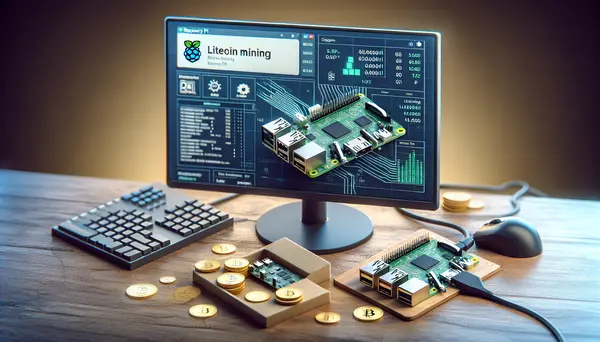
A Raspberry Pi 4 Model B delivers roughly 0.5–1.5 KH/s using its CPU with optimized software — compare that to a mid-range Scrypt ASIC producing 1,000+ MH/s, and you immediately grasp the performance chasm. The Pi's 4W–8W consumption is admirable, but at those hash rates, you'd mine a negligible fraction of a satoshi-equivalent LTC per day even in the most favorable pool configurations. If you want to pursue this path seriously, the step-by-step process of setting up a Pi as a mining node is worth understanding — particularly for running lightweight pool-connected miners or as a controller device for USB ASIC dongles like the GekkoScience Compac series, which reach 8–25 GH/s at under 10W.
The Pi genuinely shines as a mining rig management hub rather than a mining device itself. Running CGMiner or BFGMiner on a Pi to control attached USB ASICs costs roughly $35–$50 for the hardware and consumes minimal electricity. This hybrid approach extracts real utility from the platform without pretending the Pi's native compute power is competitive.
Smartphone Mining: The Thermal and Economic Dead End
Mobile CPU architectures are even less suited to Scrypt hashing than desktop processors. A flagship Snapdragon 8 Gen 2 might produce 50–150 H/s — thousandths of a KH/s — while simultaneously throttling due to thermal limits and degrading battery chemistry through sustained load cycles. Most Android mining apps targeting LTC are either outright scams harvesting device data or so inefficient that the wear-and-tear cost exceeds any conceivable reward. The detailed breakdown of what mobile mining on current hardware actually yields confirms these numbers across multiple device generations. The one exception worth mentioning: some operators use smartphones as remote monitoring dashboards for actual ASIC rigs, which is a perfectly valid and cost-effective use case.
For those determined to experiment with CPU-based mining on desktop hardware before investing in ASICs, selecting the right software matters more than the hardware specification at these performance levels. Choosing optimized CPU mining software — particularly builds with AVX2/AVX-512 instruction set support — can increase hash rates by 20–40% compared to generic releases, which at least maximizes whatever marginal output the hardware can deliver.
Entry-Level ASIC Rigs: The Actual Starting Point for Serious Mining
If budget is genuinely constrained but LTC earnings are the goal, the minimum viable entry point is a used Scrypt ASIC — devices like the Bitmain Antminer L3+ (504 MH/s) can be found secondhand for $30–$80. At current difficulty and LTC prices, profitability is marginal to zero after electricity, but the learning curve value is real. Scaling to a small multi-unit operation is where economics shift — and understanding the full architecture before that investment is why building an optimized rig from the ground up with proper power delivery, cooling, and network infrastructure pays dividends long-term. Low-cost approaches teach the fundamentals; purpose-built rigs deliver the returns.
FAQ About Litecoin Mining in 2025
What is Litecoin mining?
Litecoin mining is the process by which new LTC coins are created and transactions are verified on the Litecoin blockchain using computational power.
How does the Scrypt algorithm impact hardware choices for mining Litecoin?
The Scrypt algorithm necessitates high memory bandwidth, leading miners to predominantly use ASIC hardware that is specifically designed to optimize performance for this algorithm.
Is solo mining Litecoin profitable in 2025?
Solo mining is generally not profitable for most individuals due to the high network hashrate. It requires substantial computational power and often results in long wait times for mining rewards.
What factors should I consider when selecting Litecoin mining hardware?
Key factors include the hardware's hashrate efficiency (in J/MH), power consumption, cooling requirements, and firmware options for optimal performance.
How can I improve the profitability of my Litecoin mining operation?
Improving profitability can be achieved through optimization techniques such as tuning hardware settings, enhancing cooling solutions, and selecting the right mining pool for better reward distribution.