Table of Contents:
The Mechanics of Ethereum Proof-of-Work: Block Validation, Hash Rates, and Mining Time
Before the Merge in September 2022 permanently transitioned Ethereum to Proof-of-Stake, the network ran on a Proof-of-Work (PoW) consensus mechanism that required miners to compete computationally for the right to append new blocks to the chain. Understanding how this system functioned at a technical level is not merely historical curiosity — it is foundational knowledge for anyone serious about Ethereum's architecture, its economic design, and the GPU mining ecosystem it spawned. To understand how Ethereum's consensus model evolved from its early PoW days, you need to first understand how block validation actually worked under the hood.
From Hashing to Block Validation: How PoW Actually Worked
At its core, Ethereum's PoW required miners to repeatedly hash block header data using the Ethash algorithm — a memory-hard function specifically designed to resist ASIC dominance by requiring large amounts of fast memory bandwidth rather than raw compute cycles. Miners searched for a nonce (a 64-bit number) that, when combined with the block header and hashed, produced an output below a dynamically adjusted difficulty target. This process is probabilistic: there is no shortcut, and every attempt has an equal chance of success. A miner running a rig with 200 MH/s (megahashes per second) executes roughly 200 million of these attempts every second.
Get $500 free Bitcoin mining for a free testing phase:
- Real daily rewards
- 1 full month of testing
- No strings attached
If you choose to buy after testing, you can keep your mining rewards and receive up to 20% bonus on top.
Ethash relied on a large Directed Acyclic Graph (DAG) file stored in GPU VRAM, which grew by approximately 8 MB every 30,000 blocks (roughly every 5 days). At launch in 2015, the DAG was around 1 GB; by the final PoW months in 2022, it had exceeded 5 GB — directly eliminating GPUs with less than 6 GB of VRAM from viable mining. This design choice was intentional: Ethereum's founders wanted mining to remain accessible to consumer hardware rather than proprietary ASIC farms.
Hash Rate, Network Difficulty, and Block Time as a Feedback System
Ethereum's protocol targeted a block time of approximately 13–15 seconds, enforced through an automatic difficulty adjustment that recalculated with every single block — far more granular than Bitcoin's two-week adjustment window. When total network hash rate increased (more miners joining), difficulty rose to keep block production steady. When miners left, difficulty dropped. How this block timing mechanism was calibrated and maintained reveals one of Ethereum's more elegant engineering decisions: it treated block time as a first-class protocol metric rather than an afterthought.
Network hash rate peaked at approximately 900–950 TH/s (terahashes per second) in mid-2022, representing millions of GPUs running worldwide. At that scale, any single miner with even a 1,000 MH/s (1 GH/s) rig controlled roughly 0.0001% of total hash power — underscoring why mining pools became operationally essential rather than optional. Solo mining at consumer scale was statistically equivalent to buying a single lottery ticket per day.
The transaction selection layer added another dimension of complexity. Miners did not simply validate blocks — they actively chose which transactions to include based on gas price bidding, effectively functioning as market makers for blockspace. The mechanics of how miners selected, ordered, and processed pending transactions had direct implications for MEV (Maximal Extractable Value) strategies that sophisticated mining operations exploited for significant additional revenue beyond the base block reward of 2 ETH. Tracing this economic evolution across Ethereum's mining lifecycle shows how the incentive structure matured — and ultimately made the transition to PoS both technically feasible and economically motivated.
Hardware Selection and Rig Architecture: GPUs, Components, and Cost Breakdown
The GPU is the heart of any Ethereum mining operation, and selecting the right one directly determines your hashrate, power consumption, and ultimately your return on investment. During Ethereum's proof-of-work era, the market converged around a handful of dominant cards — the NVIDIA RTX 3080 delivered roughly 97 MH/s at around 230W, while the AMD RX 6800 XT hit 64 MH/s at just 130W after memory tuning. Understanding these performance-per-watt figures matters more than raw hashrate alone, since electricity costs typically consume 60–80% of mining revenue in professional setups.
For miners who want a data-driven approach to card selection, a detailed look at which GPU configurations actually maximize your margins reveals that mid-tier cards like the RX 5700 XT often outperform flagship models on a cost-efficiency basis. A single RTX 3090 might cost $1,500 used, but six RX 580 8GB cards at $150 each can match or exceed its hashrate at nearly half the total acquisition cost — a calculus that serious miners run before every hardware purchase.
Core Rig Components Beyond the GPU
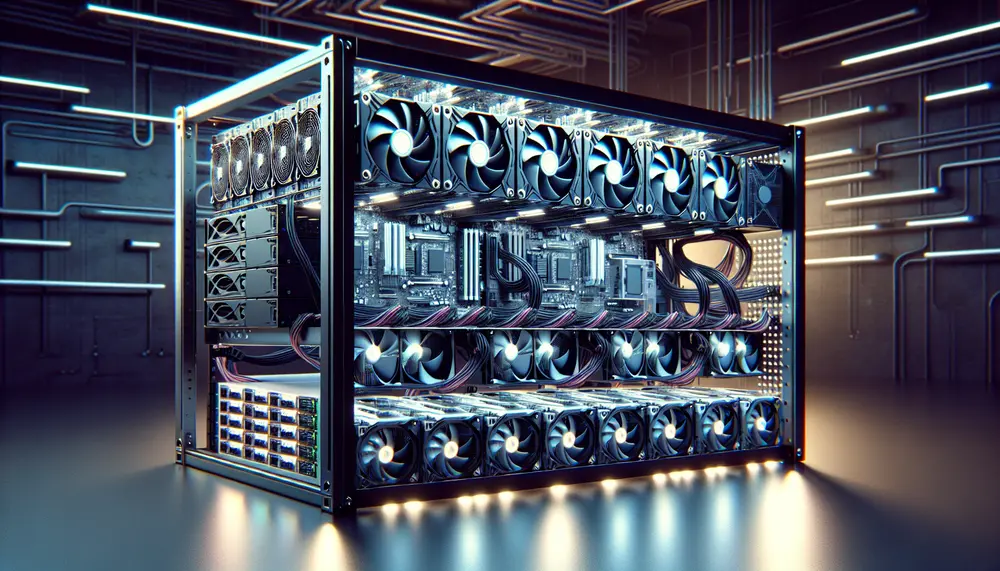
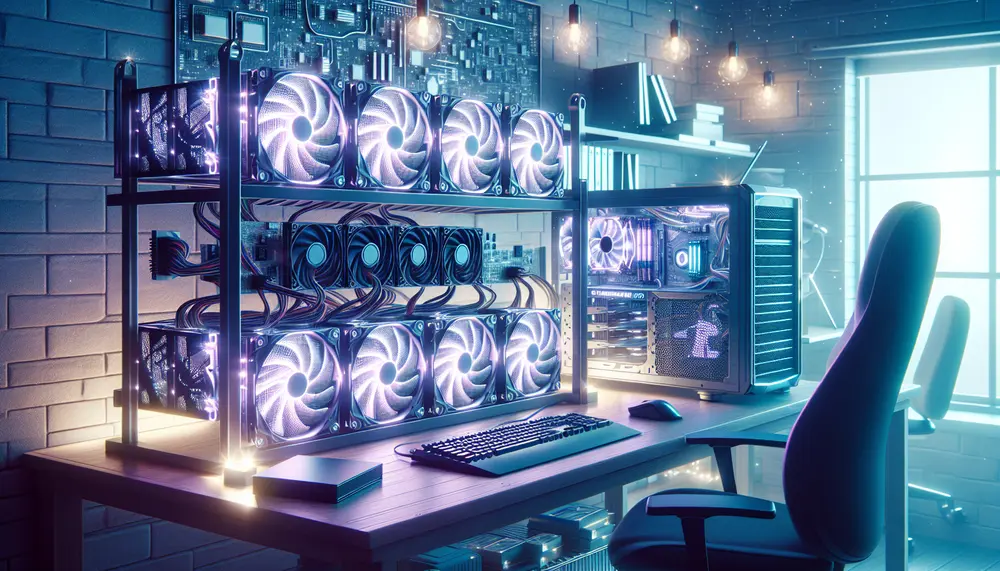
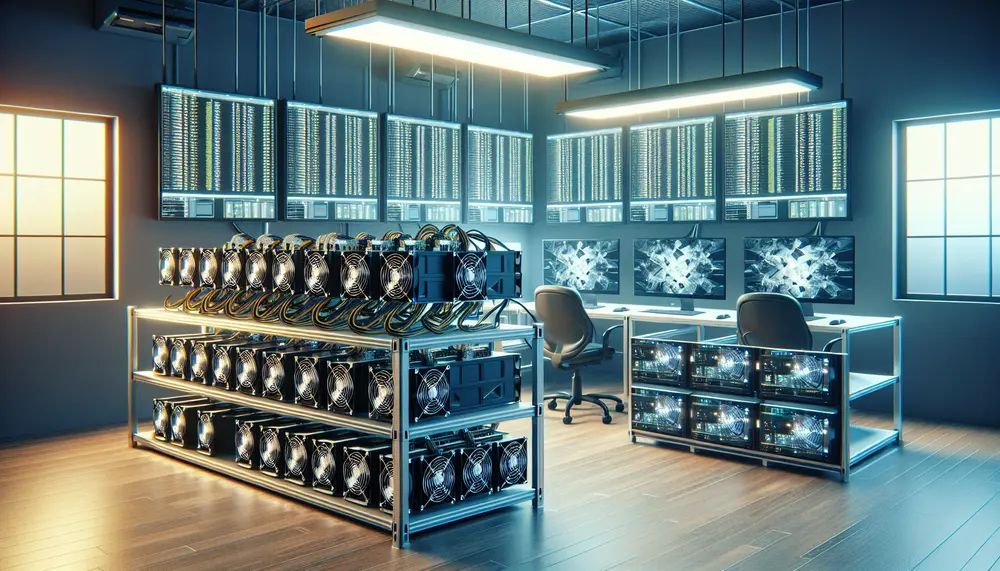
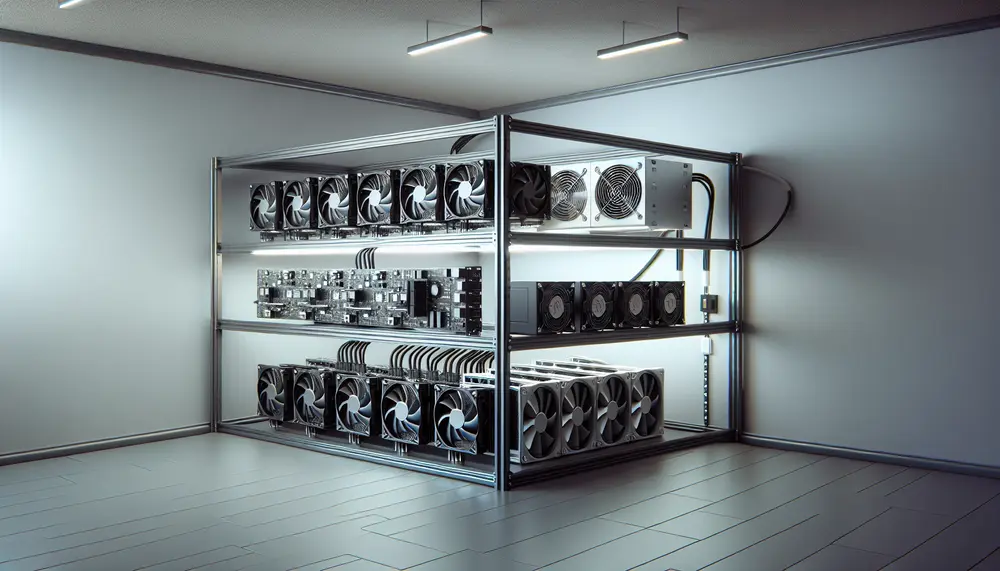
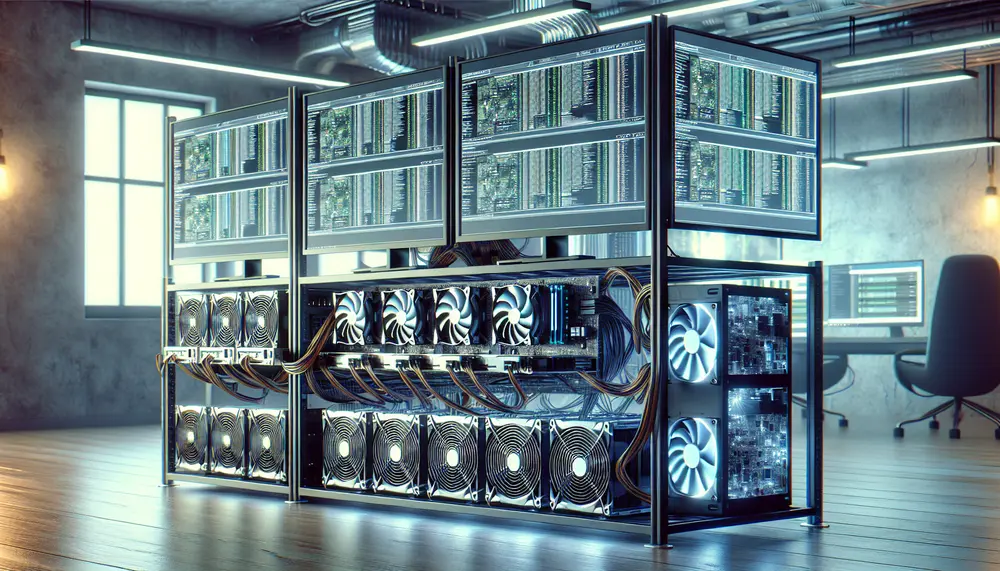
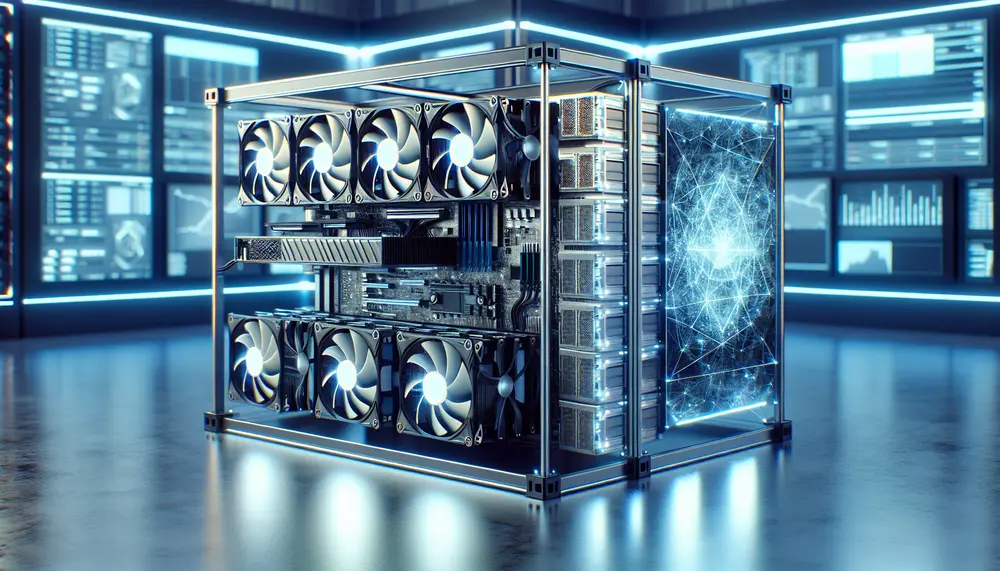
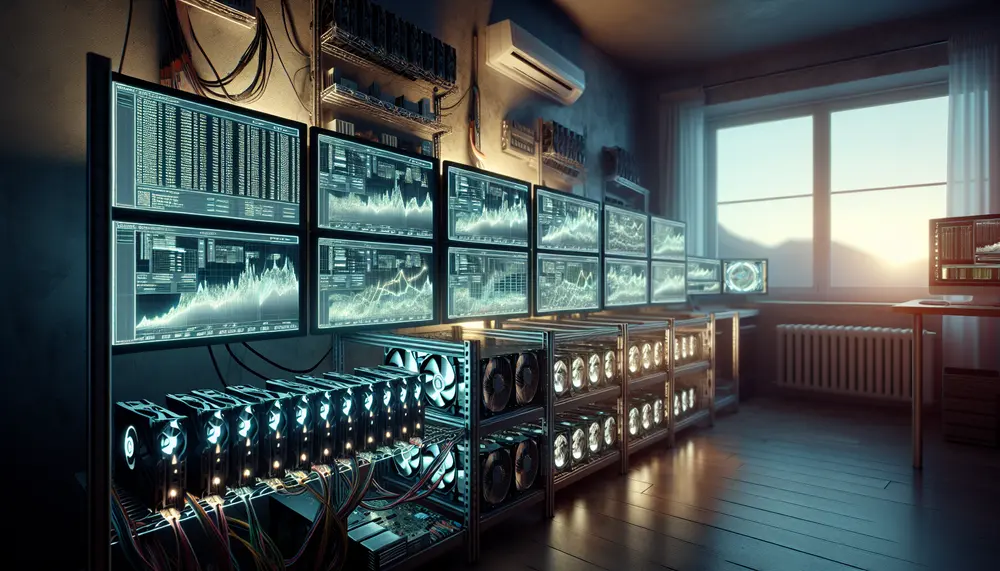
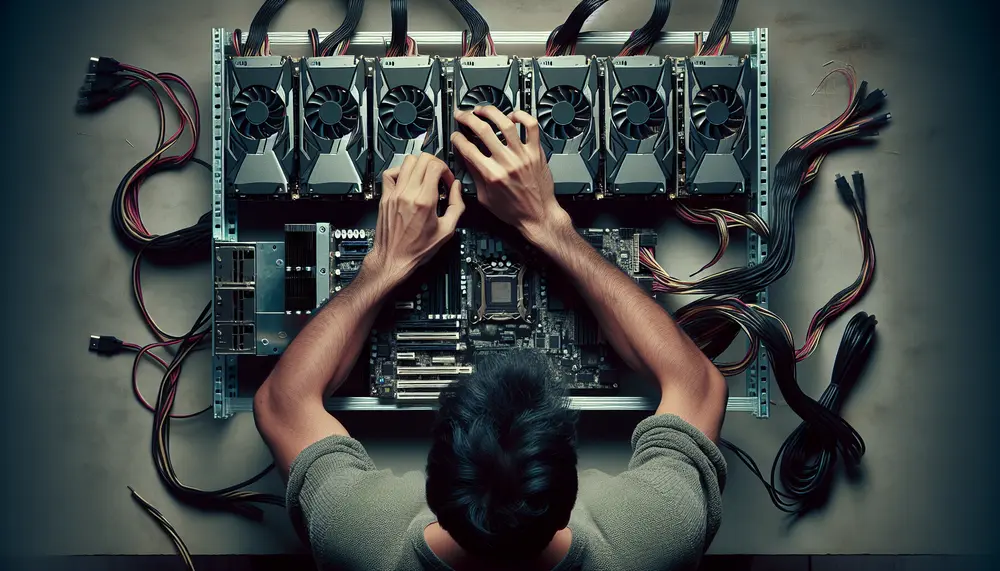
A mining rig is not just GPUs bolted together. Every component in the stack affects stability, scalability, and profitability. The motherboard must support the number of PCIe slots you intend to populate — boards like the ASRock H110 Pro BTC+ with 13 PCIe slots were purpose-built for this use case. Riser cables (powered USB 3.0 PCIe adapters) connect each GPU to the motherboard and are a notorious failure point; always keep spares and use quality-rated 006C or 007S risers. A frame — either commercial aluminum or DIY steel — allows maximum airflow and GPU spacing, which is critical when running six or more cards continuously.
- Power Supply Unit (PSU): Calculate total GPU TDP, add 20% headroom. A 6-GPU rig with 200W cards needs at minimum an 1,500W gold-rated PSU — or dual PSUs with a sync adapter.
- CPU and RAM: Mining is GPU-bound, so a basic Intel Celeron G3900 and 4GB DDR4 are sufficient. Don't over-invest here.
- Storage: A 120GB SSD running a lean Linux mining OS like HiveOS or ethOS keeps boot times fast and reduces OS-related downtime.
- Network: Wired Ethernet is non-negotiable for rigs operating 24/7 — Wi-Fi dropout causes share rejections and orphaned blocks.
Real Cost Expectations and Budget Planning
New miners consistently underestimate total build costs. A realistic breakdown of what an Ethereum mining rig actually costs from frame to first block shows that non-GPU components — PSU, motherboard, risers, frame, and OS license — typically add $400–$700 to any build regardless of GPU count. That fixed overhead means scaling to 8–12 GPUs per rig improves your cost-per-MH/s significantly compared to running two or three cards.
Before purchasing any hardware, model your payback period using live network difficulty and current ETH prices. In peak 2021 conditions, a 6-GPU RX 5700 XT rig generating ~360 MH/s returned its ~$5,000 investment in under four months. Market conditions shift rapidly, but the component-selection logic remains constant. For the step-by-step assembly process, the complete rig setup workflow covers BIOS configuration, riser connections, and driver installation in sequence. Miners building their first system should also consult a hands-on guide that walks through the full build process, including common mistakes around PCIe power connectors and virtual memory configuration that cost beginners days of troubleshooting.
Mining Pool Strategies: Fee Structures, Payout Models, and Pool Selection
Joining a mining pool is not a passive decision — the pool you select directly determines your net profitability, payout frequency, and operational risk. With Ethereum Classic (ETC) and other proof-of-work Ethereum forks still viable post-Merge, understanding pool mechanics is as critical as optimizing your GPU settings. Even a 1% fee difference compounds significantly at scale: a miner generating 500 MH/s paying 2% instead of 1% loses roughly $15–25 per month depending on ETC price, before even accounting for payout model inefficiencies.
Fee Structures: What You're Actually Paying
Most pools charge between 0.5% and 2% of your gross mining rewards. Some advertise 0% fees but offset this through transaction fee withholding or inflated minimum withdrawal thresholds that lock up your capital. The fee type matters as much as the percentage itself. PPLNS (Pay Per Last N Shares) pools typically charge 0.5–1%, while PPS (Pay Per Share) pools often charge 1.5–2% because they absorb variance risk on behalf of miners — you receive a fixed payout per valid share regardless of whether the pool finds a block. For miners with consistent rigs running 24/7, PPS offers predictable cash flow; for those with intermittent hardware, PPLNS rewards loyalty through its luck-weighting mechanism.
FPPS (Full Pay Per Share) has become the dominant model among serious miners because it includes transaction fees in the payout calculation, not just block rewards. On high-congestion networks, transaction fees can represent 10–30% of total block value, making FPPS materially superior to standard PPS during fee spikes. When evaluating which pool structure maximizes your actual returns, always compare FPPS vs. PPS+MEV options, as some modern pools also distribute Maximal Extractable Value to miners.
Payout Thresholds and Liquidity Considerations
Minimum payout thresholds directly impact your working capital. A pool requiring 0.1 ETC minimum (~$2.50 at current prices) frees up cash faster than one requiring 0.5 ETC. For smaller operations running 2–4 GPUs, high thresholds mean your earned coins sit idle for days or weeks, exposed to price volatility. If you prefer receiving payouts in stablecoins to hedge that exposure, pools that pay out directly in USDT eliminate conversion friction and protect margins during bear markets — though they typically charge a small conversion spread of 0.1–0.3%.
Pool hashrate distribution is the other critical selection factor. Pools controlling more than 40% of network hashrate represent centralization risk — a pool that finds blocks too frequently can theoretically execute selfish mining attacks. Practically, it also means you should diversify across 2–3 pools if your operation exceeds 1 GH/s. Mid-tier pools in the 5–15% hashrate range often offer the best balance of block frequency, server stability, and competitive fees.
Due diligence before committing is non-negotiable. The post-Merge landscape attracted numerous fraudulent operations targeting miners displaced from Ethereum mainnet. Learning to identify the warning signs that distinguish legitimate pools from fraudulent ones — such as unverifiable block history, anonymous teams, or withdrawal delays — should precede any deposit or pointing of hashrate. Always verify a pool's block discovery history on-chain independently before mining for more than 24 hours.
- Test new pools with 10–20% of your hashrate for 48–72 hours before full commitment
- Compare effective hashrate reported by the pool against your rig's local readings — discrepancies above 3–5% indicate share rejection issues
- Check server latency to your geographic region; above 80ms introduces meaningful stale share rates
- Review payout history on community forums like BitcoinTalk or Discord servers before trusting withdrawal claims
Profitability Analysis: Energy Costs, kWh Calculations, and ROI Benchmarks
Before committing capital to any mining operation, the numbers have to work — and they have to work under conservative assumptions, not optimistic ones. The core profitability equation is deceptively simple: daily revenue minus daily electricity cost equals gross profit. But the variables inside that equation carry enormous weight. ETH price swings of 20% in a week, difficulty adjustments every epoch, and electricity rate differences of $0.04/kWh versus $0.12/kWh can be the difference between a thriving operation and one hemorrhaging cash. Anyone serious about this space should deeply understand whether the economics of running a mining rig actually hold up before purchasing a single GPU.
Breaking Down the kWh Calculation
The practical starting point is your rig's power draw. A 6-GPU mining rig built around RTX 3070s running at optimized settings might pull approximately 750W at the wall — not the GPU TDP alone, but the full system load including motherboard, CPU, RAM, and PSU inefficiency (typically 85–92% efficiency for quality units). Running that rig for 24 hours consumes 18 kWh per day. At $0.06/kWh (achievable in parts of the US, Kazakhstan, or with industrial contracts), that's $1.08/day in electricity. At $0.12/kWh, that doubles to $2.16/day. Mastering the methodology behind accurate kWh calculations lets you model these scenarios precisely rather than guessing. Tools like a Kill-A-Watt meter or smart PDU with real-time monitoring eliminate estimation entirely — measure actual wall draw, then multiply by your local rate.
The efficiency metric that separates amateur from professional miners is MH/J (megahash per joule). An RTX 3080 pushing 100 MH/s at 220W delivers roughly 0.45 MH/J. A GTX 1080 Ti hitting 45 MH/s at 180W delivers 0.25 MH/J — nearly half the efficiency. When electricity costs dominate your P&L, efficiency per watt matters more than raw hashrate. The broader implications for grid load and carbon footprint also can't be ignored; the scale of Ethereum's historical energy footprint became a central regulatory and ESG concern that reshaped how jurisdictions approached mining legislation.
ROI Benchmarks and Realistic Payback Periods
In the pre-Merge environment, a well-optimized 6-GPU RTX 3070 rig (cost: ~$4,500 all-in during 2021 peaks) generating 360 MH/s might have returned $8–12/day gross at ETH prices above $3,000 and moderate difficulty. After electricity, net returns of $5–9/day implied a payback period of 500–900 days — borderline acceptable for depreciating hardware in a volatile market. Budget hardware changes the calculus significantly; understanding the trade-offs of running lower-tier cards like the GTX 1650 reveals why entry-level GPUs often fail to generate acceptable ROI once electricity is factored in, despite their attractive purchase price.
Key profitability levers every miner should actively manage:
- Electricity rate negotiation: Industrial tariffs, off-peak scheduling, or relocating to low-cost regions can cut operating expenses by 40–60%
- Undervolting: Reducing core voltage on an RTX 3060 Ti can drop power consumption from 200W to 120W while maintaining 98% of hashrate
- Pool fee selection: A 1% fee difference on a 500 MH/s rig compounds to meaningful losses over 12 months
- Hardware resale value: GPUs retain secondary market value; factoring salvage value into ROI calculations shortens effective payback periods by 15–25%
The break-even electricity price is arguably the single most critical number to calculate upfront. Divide your daily revenue by daily kWh consumption to find the maximum rate you can pay and still mine at zero profit — anything below that is margin, anything above is a loss. Operations running above $0.10/kWh on standard consumer hardware without offsetting factors rarely survive extended bear markets.
Mining Software, Bots, and Apps: Automation and Optimization Tools
Before the Merge in September 2022 ended Ethereum's proof-of-work consensus, miners spent years optimizing their software stacks to squeeze every last megahash out of their rigs. That tooling ecosystem didn't disappear — it evolved. Today, the same software frameworks power Ethereum Classic (ETC), ETHPoW, and a dozen other Ethash-based chains, making software selection as critical as hardware choice. The right stack can realistically improve your effective hashrate by 5–15% compared to running stock drivers and generic miners.
Core Mining Clients: Where Performance Is Won or Lost
T-Rex Miner remains the gold standard for NVIDIA GPUs on Ethash, consistently benchmarking 1–2% ahead of competitors while offering a built-in HTTP API for real-time monitoring. lolMiner dominates on AMD hardware, with its dual-mining mode allowing simultaneous Ethash and Alephium mining — a combination that adds meaningful secondary income without significant primary hashrate loss. PhoenixMiner and GMiner round out the serious options, each with distinct advantages depending on your specific GPU model and driver version. Never run a miner without verifying its SHA256 hash against the official release — supply-chain attacks on mining software are documented and ongoing.
Configuration tuning goes far beyond pointing the software at a pool URL. The --mt flag in T-Rex enables memory tweak levels (1–6 on NVIDIA), which can push a stock RTX 3080 from 95 MH/s to 102+ MH/s with zero hardware modification. Similarly, strap flashing AMD RX 6000 series cards through lolMiner's timing strap parameters can yield 8–12% efficiency gains. These aren't theoretical numbers — they're documented in the mining community's benchmark repositories with reproducible results.
Automation, Bots, and Mobile Management
Managing a farm of 20+ GPUs manually is operationally unsustainable. Modern automation operates on two levels: pool-side optimization and local farm management. Platforms like Awesome Miner and Minerstat provide centralized dashboards that detect hardware faults, auto-restart crashed instances, and switch algorithms dynamically based on profitability data. For miners exploring algorithmic switching and auto-conversion features, understanding how automated bots handle pool-hopping and payout optimization is essential before committing hashrate to any single destination.
The mobile monitoring space has matured significantly. Dedicated mining applications designed to maximize rig earnings now offer push notifications for worker dropouts, temperature alerts above user-defined thresholds, and remote power cycling through smart PDU integrations. For newcomers still building their first setup, starting with NiceHash's integrated ecosystem offers a gentler learning curve — the platform handles algorithm selection, buyer matching, and BTC payouts automatically, sacrificing roughly 2–5% in fees compared to direct pool mining.
Android-based solutions deserve honest context. While mobile APK mining clients exist and can connect to pools, smartphone GPUs generate negligible hashrates — typically under 1 KH/s — making them economically irrelevant for serious operations. Their practical value lies in remote monitoring and farm management, not hashrate contribution. Any app claiming significant mobile mining profitability should be treated as a red flag for potential scams or unwanted background resource harvesting.
- Always verify miner binaries against official checksums before deployment
- Benchmark each miner independently — optimal clients vary by GPU generation and VRAM type
- Set hardware watchdogs at the BIOS level as a failsafe beyond software monitoring
- Log profitability data with timestamps to correlate software updates with performance changes
FAQ zum Ethereum Mining: Ultimate Guide 2026
Was ist Ethereum Mining?
Ethereum Mining ist der Prozess, durch den neue Ether (ETH) erzeugt werden. Miner verwenden leistungsstarke Computer, um komplexe mathematische Probleme zu lösen, um Transaktionen zu verifizieren und neue Blöcke zur Ethereum-Blockchain hinzuzufügen.
Wie funktioniert der Mining-Prozess bei Ethereum?
Miner nutzen den Ethash-Algorithmus, um Nonces zu finden, die spezielle Bedingungen erfüllen. Der Prozess ist wettbewerbsfähig und probabilistisch, wobei Miner mit den schnellsten und leistungsfähigsten Hardware-Rigs die besten Chancen haben, neue Blöcke zu finden.
Welche Hardware benötige ich für das Ethereum Mining?
Für das Ethereum Mining sind Grafikkarten (GPUs) erforderlich, die mehrere Megahashes pro Sekunde (MH/s) liefern können. Beliebte Modelle sind die NVIDIA RTX 3080 und die AMD RX 6800 XT. Zudem sind weitere Komponenten wie Motherboard, PSU, RAM und Netzwerkschnittstelle notwendig.
Was sind Mining-Pools und brauche ich einen?
Mining-Pools sind Gruppen von Minern, die ihre Ressourcen bündeln, um die Chancen auf das Finden eines Blocks zu erhöhen. Ja, ein Mining-Pool ist praktisch notwendig, da Solo-Mining mit einem normalen GPU-Rig oft nicht profitabel ist.
Wie berechne ich die Rentabilität meines Mining-Setups?
Um die Rentabilität zu bestimmen, ziehen Sie die täglichen Stromkosten von den täglichen Erträgen ab. Faktoren wie ETH-Preis, Mining-Schwierigkeit und Stromkosten pro kWh spielen dabei eine entscheidende Rolle. Tools zur Rentabilitätsanalyse helfen bei dieser Berechnung.