Table of Contents:
Bitcoin Mining and Its Connection to Agriculture
Bitcoin (BTC) is a digital currency that exists solely on the internet, operating without a central authority like a bank or government. All transactions are verified by numerous computers worldwide and recorded on a public ledger known as the blockchain, making fraud significantly more difficult. The total supply of Bitcoin is capped at 21 million, with 1 BTC equating to 100,000,000 Satoshis. As of February 2026, the value of 1 BTC is approximately €65,000, although the price is highly volatile. (Source: top agrar)
“Bitcoin Mining should be seen as a component of the energy concept on the farm, not as a quick gold mine.”
Mining, or "schürfen" in German, refers to the process of producing new Bitcoin. Specialized computers, known as ASICs, perform calculations to unlock a new block approximately every 10 minutes. The miner who successfully finds a block receives a defined reward in Bitcoin, currently set at 3.125 BTC per block. The mining process is heavily reliant on electricity, with around 80% of operational costs attributed to power consumption. This makes access to cheap electricity crucial for profitability. (Source: top agrar)
Get $500 free Bitcoin mining for a free testing phase:
- Real daily rewards
- 1 full month of testing
- No strings attached
If you choose to buy after testing, you can keep your mining rewards and receive up to 20% bonus on top.
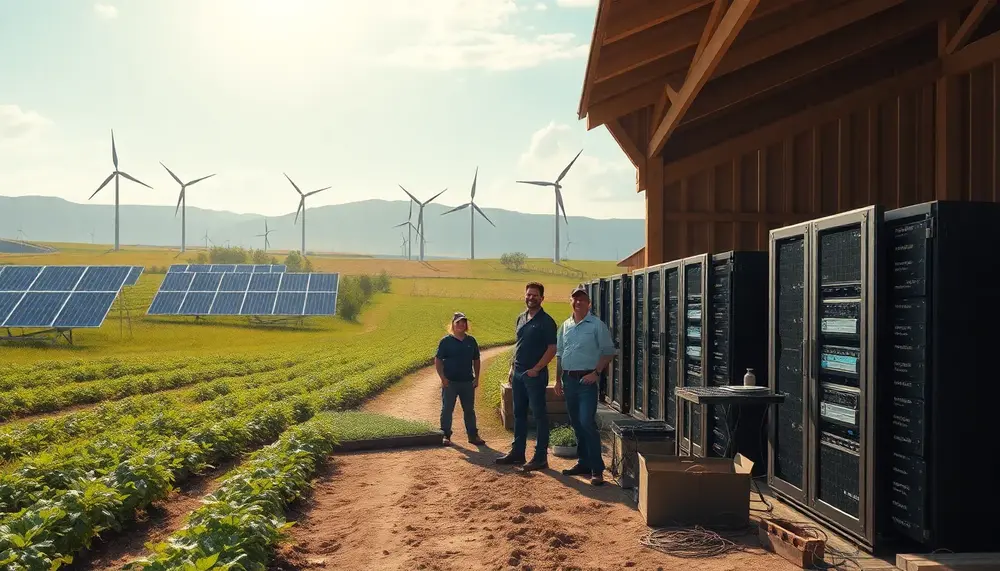
Many agricultural businesses have photovoltaic (PV) or wind power systems, often with expiring feed-in tariffs and low compensation rates. This creates a potential synergy with Bitcoin mining, as mining computers can operate directly on the farm using surplus electricity. Additionally, the waste heat generated from mining can be utilized for heating barns or greenhouses, or for drying wood and pellets. (Source: top agrar)
However, Bitcoin mining is not without its challenges. The profitability of mining operations can fluctuate significantly based on the price of Bitcoin and the costs associated with mining hardware. Currently, mining equipment prices can range from €3,000 to €15,000, depending on market conditions. (Source: top agrar)
For farmers considering Bitcoin mining, it is essential to evaluate their energy and heating needs first. Mining can be economically viable if electricity generation costs are between 6-7 cents per kWh, especially when combined with income from selling waste heat. A single miner typically consumes between 3.5 to 5.5 kW, translating to approximately 70-130 kWh of electricity per day. (Source: top agrar)
In conclusion, Bitcoin mining presents both opportunities and risks for agricultural businesses. While it can provide an additional income stream through the utilization of surplus energy and waste heat, the volatility of Bitcoin prices and the significant energy consumption involved must be carefully considered. (Source: top agrar)
Bitcoin-Linked Stocks Outperforming BTC
As of February 25, 2026, several Bitcoin mining stocks listed on US exchanges have shown remarkable performance, outpacing the volatile price of Bitcoin itself. For instance, Terawulf (WULF) shares have surged by 31% this month, despite Bitcoin's spot price dropping nearly 17%. Other companies like Cipher Digital (CIFR) and HUT 8 (HUT) have also seen increases of 8% and 6%, respectively. (Source: CoinDesk)
Markus Thielen, founder of 10x Research, noted that these companies have secured long-term energy contracts, providing them with a strategic advantage beyond mere Bitcoin mining. This trend indicates a shift in investor focus towards companies with sustainable operational models, as traditional mining firms may struggle to keep pace. (Source: CoinDesk)
Bitcoin's price has recently climbed above $65,000, likely influenced by gains in futures tied to the Nasdaq-100 index. However, analysts caution that a sustained drop below $60,000 could trigger further declines, with $57,500 identified as a critical support level. Conversely, reclaiming the $72,000 to $75,000 range would signal a return of risk appetite among investors. (Source: CoinDesk)
In summary, while Bitcoin mining stocks are currently outperforming Bitcoin itself, the market remains sensitive to price fluctuations and broader economic indicators. Investors should remain vigilant as the landscape continues to evolve. (Source: CoinDesk)
Sources: