Table of Contents:
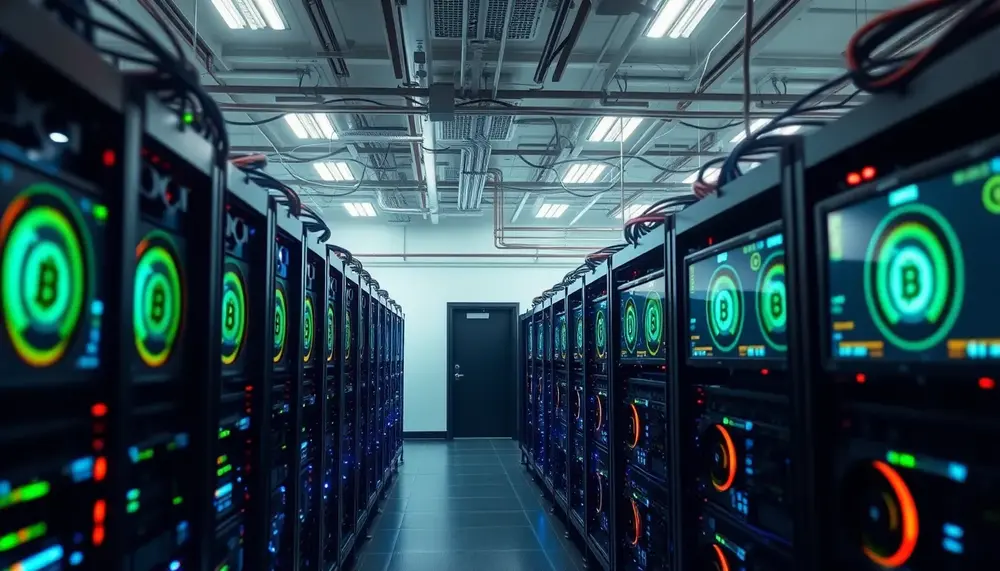
Bitcoin Mining at the Limit: AI Takes Over the Racks
The Bitcoin mining sector is undergoing significant changes as high costs, decreased fees, and the rise of artificial intelligence (AI) compel miners to rethink their strategies. According to the CoinShares Bitcoin Mining Report Q4 2025, the sector has reached a turning point, with production costs hitting an all-time high and the hash price plummeting.
As of Q2 2025, the average cash cost for mining one BTC by public miners rose to approximately $74,600, while total costs climbed to $137,800. Transaction fees, which once provided a buffer for miner revenues, fell below 1% of block rewards in May and June, marking the weakest amount since the 2024 halving. Despite shrinking margins, the Bitcoin network continued to grow, surpassing 1 Zetta Hash/s for the first time in August.
Get $500 free Bitcoin mining for a free testing phase:
- Real daily rewards
- 1 full month of testing
- No strings attached
If you choose to buy after testing, you can keep your mining rewards and receive up to 20% bonus on top.
"The superior economics of AI, hyperscaler deal flows, and rising costs of industrial mining are driving the industry into a permanent transformation," stated the report.
In summary, the Bitcoin mining landscape is shifting dramatically, with miners facing unprecedented challenges and the need to adapt to new economic realities.
China Reaffirms Crypto Ban and Targets Stablecoins
On November 28, 2025, the People's Bank of China held a coordination meeting to combat speculative trading and illegal activities involving cryptocurrencies. High-ranking representatives from 13 key agencies attended, emphasizing the consistent implementation of anti-crypto measures established in 2021. The central bank noted a resurgence in speculation and related illegal activities with digital assets.
The recent resolution reiterated that cryptocurrencies are not legal tender and cannot circulate or be used as currency in the market. All transactions involving cryptocurrencies are deemed illegal financial activities. The authorities have now specifically targeted stablecoins, categorizing them as a central risk factor due to their potential for money laundering and fraud.
In conclusion, China's regulatory stance remains stringent, with a clear focus on maintaining economic stability and controlling financial risks associated with cryptocurrencies.
Malaysia Cracks Down on Illegal Bitcoin Mining
In Malaysia, the fight against illegal Bitcoin mining has escalated into a "cat-and-mouse game." Authorities are employing drones to detect unusual heat sources indicative of illegal mining operations, while police use sensors to monitor suspicious electricity consumption. Over the past five years, Malaysia has uncovered around 14,000 illegal mining sites, resulting in losses of approximately $1.1 billion for the state energy company Tenaga Nasional due to electricity theft.
On November 19, the Malaysian government established a special inter-ministerial committee to coordinate efforts against illegal mining operators. Deputy Minister Akmal Nasrullah Mohd Nasir highlighted that these activities pose serious challenges to the power grid and could damage infrastructure.
In summary, Malaysia is intensifying its crackdown on illegal Bitcoin mining, reflecting the significant economic impact and risks associated with unregulated operations.
Sources:
- Bitcoin-Mining am Limit: KI erobert die Racks
- China bekräftigt „Krypto-Verbot“ und nimmt Stablecoins ins Visier
- Bitcoin-Hashrate bleibt fest über 1 ZH/s nach einigen schmerzhaften Wochen für Miner
- Bitfarms Aktie: Exzellent vorbereitet!
- Stromdiebstahl von über 1.1 Milliarden US-Dollar: Malaysische Bitcoin-Miner werden streng verfolgt